

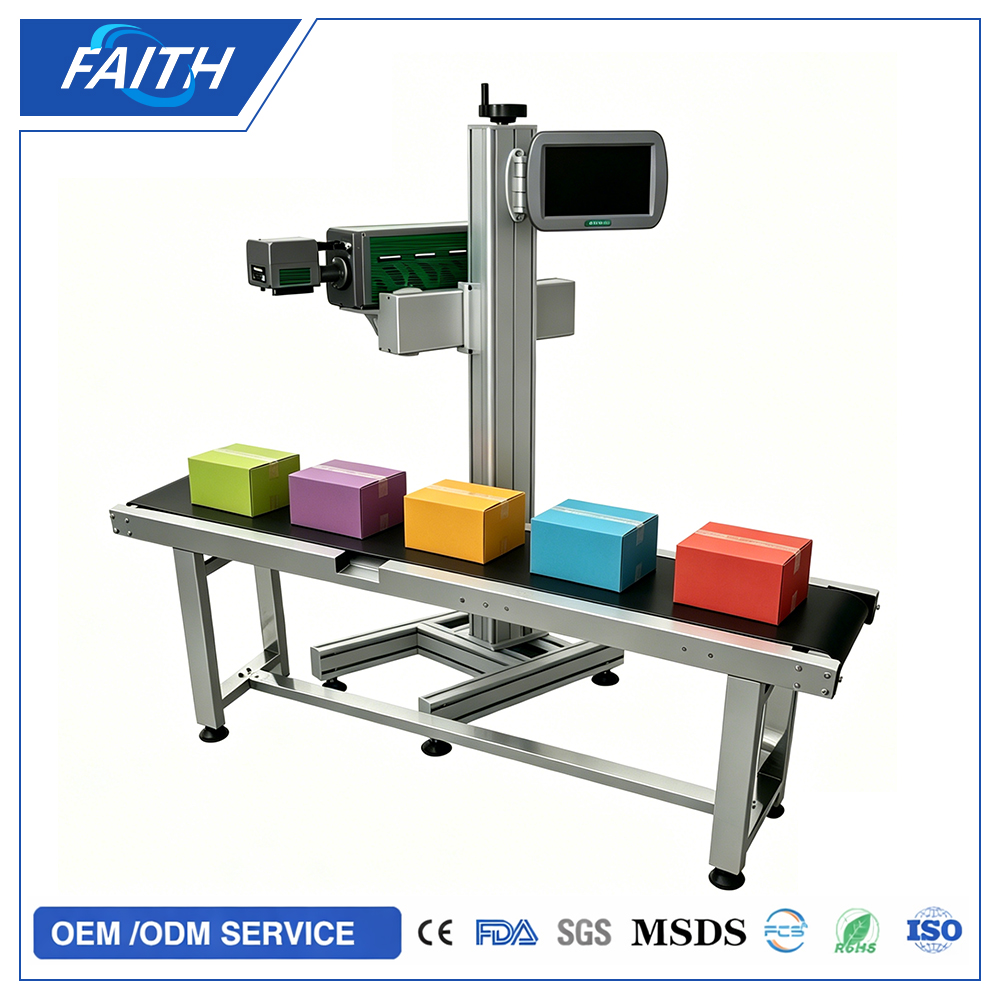
As a key piece of equipment in industrial automated production lines, the fiber optic Flying laser marking machine, with its dynamic tracking marking technology, achieves precise marking of products during high-speed transmission, completely breaking the limitations of traditional static marking on production efficiency. Using fiber lasers as its core, combined with a flying optical path and a high-speed galvanometer system, it has become a standard feature in large-scale production in industries such as automotive, electronics, and food, reshaping the efficiency and precision standards of industrial marking.
The core advantages of this equipment are reflected in its multi-dimensional breakthroughs. In terms of speed, models equipped with imported fiber lasers can achieve marking speeds exceeding 10,000 mm/s, with a single-piece marking time as low as 1 second, perfectly adapting to high-speed production lines producing hundreds of pieces per minute, completing continuous marking without interruption. In terms of precision, the laser beam quality is excellent (M²<1.1), with a focused spot diameter ≤20μm, achieving fine marking at the 0.001mm level, ensuring clear and neat markings on both micro-electronic components and large pipes.
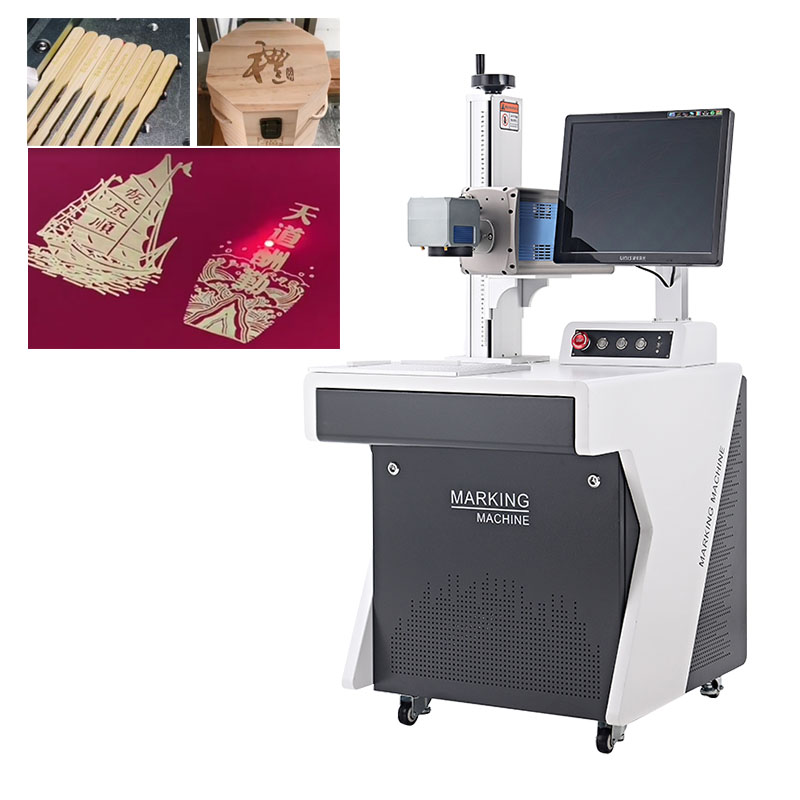
Adaptability and durability are another major highlight. It can easily handle various materials such as stainless steel, aluminum alloy, plastic, and ceramics, providing wear-resistant and corrosion-resistant marking effects. It can withstand extreme environments such as high temperatures, sulfidation, and liquid immersion, making it particularly suitable for scenarios with extremely high durability requirements, such as automotive parts and outdoor pipes. Simultaneously, the equipment adopts a consumable-free design, with an electro-optical conversion efficiency exceeding 30%, energy consumption only one-third that of traditional equipment, and a laser source lifespan of up to 100,000 hours, significantly reducing maintenance costs.
Its intelligent integration capabilities allow it to deeply integrate into Industry 4.0 systems. The equipped industrial-grade control system can seamlessly interface with PLC and MES systems, supporting direct import of AutoCAD files, enabling automatic serial number generation, database linkage, and other functions. Some high-end models are equipped with a CCD vision positioning system, which can accurately identify the marking area, ensuring marking consistency even on curved and irregular surfaces, reducing manual intervention and scrap rates.
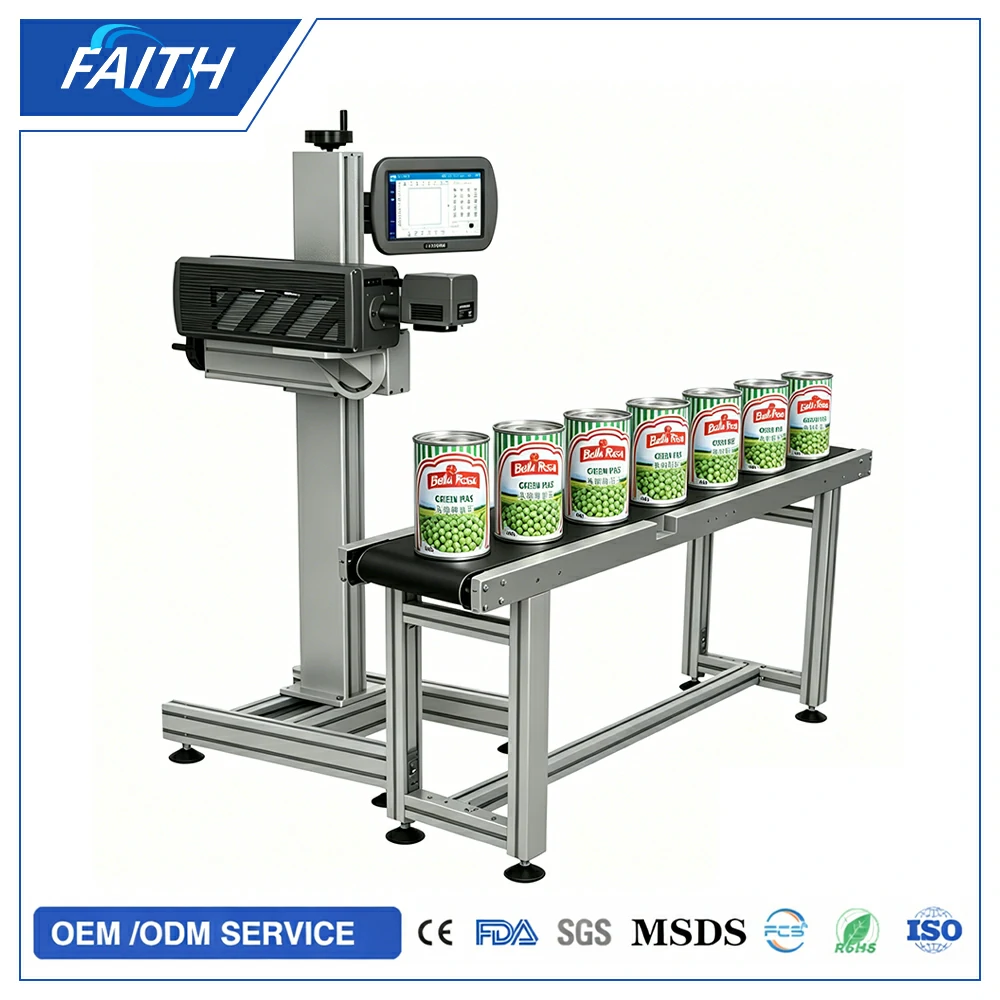
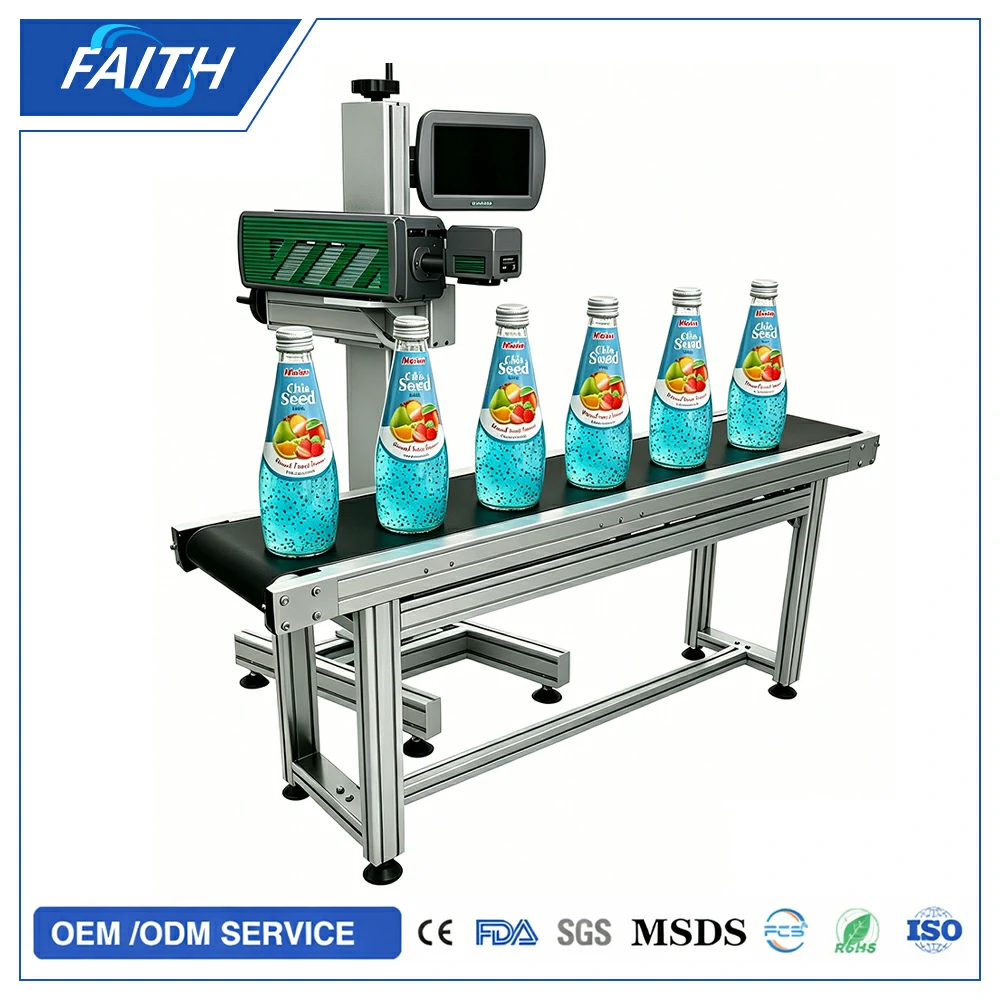
Its applications cover the entire industrial sector: the automotive industry uses it for marking VIN codes on engine parts and tire traceability codes; the electronics industry marks PCB board serial numbers and chip specifications; the food and beverage industry marks production dates and traceability codes on packaging; and the pharmaceutical industry meets GMP standards by accurately marking drug batch numbers and expiration dates.
With its core characteristics of "high speed, precision, durability, and intelligence," the fiber-optic flying laser marking machine not only meets the compliance and traceability needs of modern industry but also creates value for enterprises through efficiency improvements and cost control, becoming an important support for promoting the intelligent upgrading of the manufacturing industry.
Please leave the message you want to inquiry. We will reply you as soon as possible within 24 hours.
Please leave the message you want to inquiry. We will reply you as soon as possible within 24 hours.