

In many factories, the coding machine is not the biggest equipment on the line, but it often causes some of the most annoying problems.
A beverage factory may have a filling machine running smoothly at 80 bottles per minute, a labeling machine already adjusted, and cartons waiting at the end of the line. Then the operator stops everything because the date code is blurred. The inkjet printer nozzle is blocked again. The ink is too light on the plastic cap. The production manager has to decide whether to keep running with poor codes or stop the whole line for cleaning.
This kind of problem is common in food, beverage, cosmetic, pharmaceutical, cable, pipe, carton and daily chemical factories. The product itself may be good, but if the batch number, expiry date or QR code is unreadable, the goods may be rejected by distributors, supermarkets or customs inspection.
That is one reason many factories start looking at Flying laser marking machines.
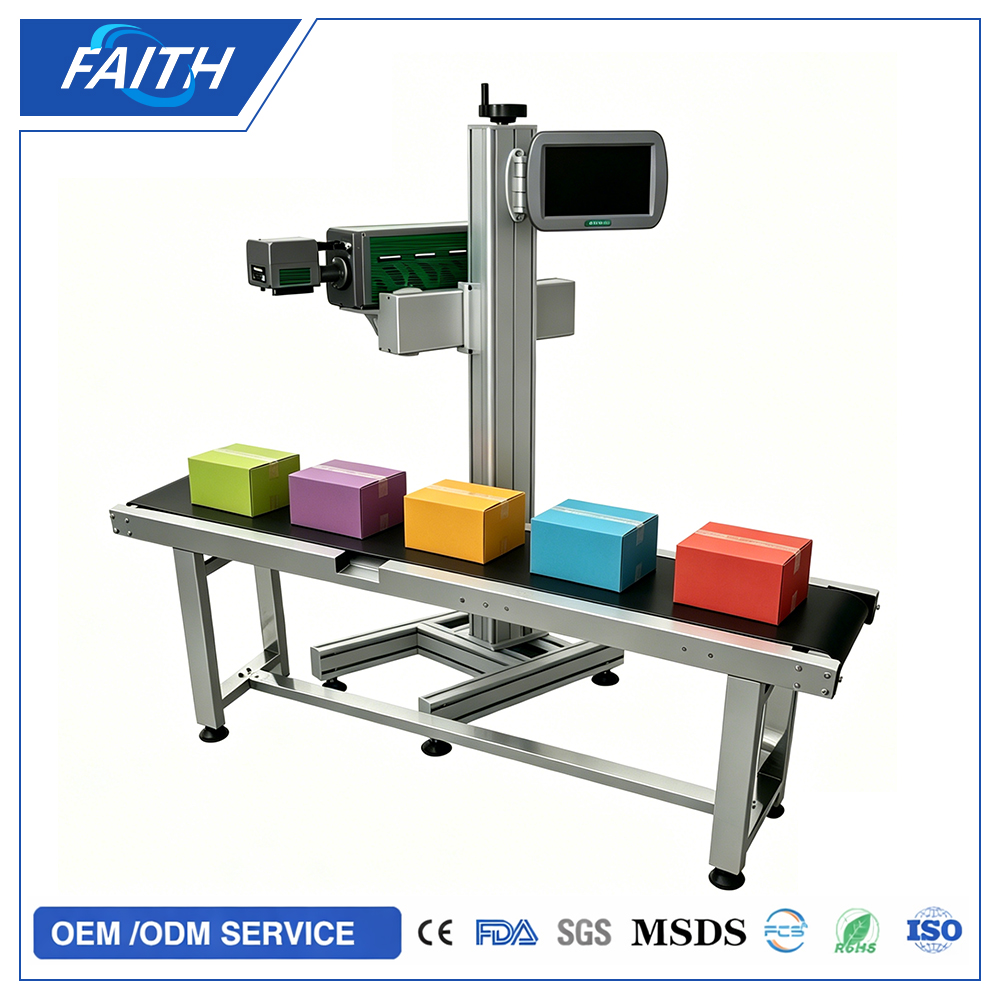
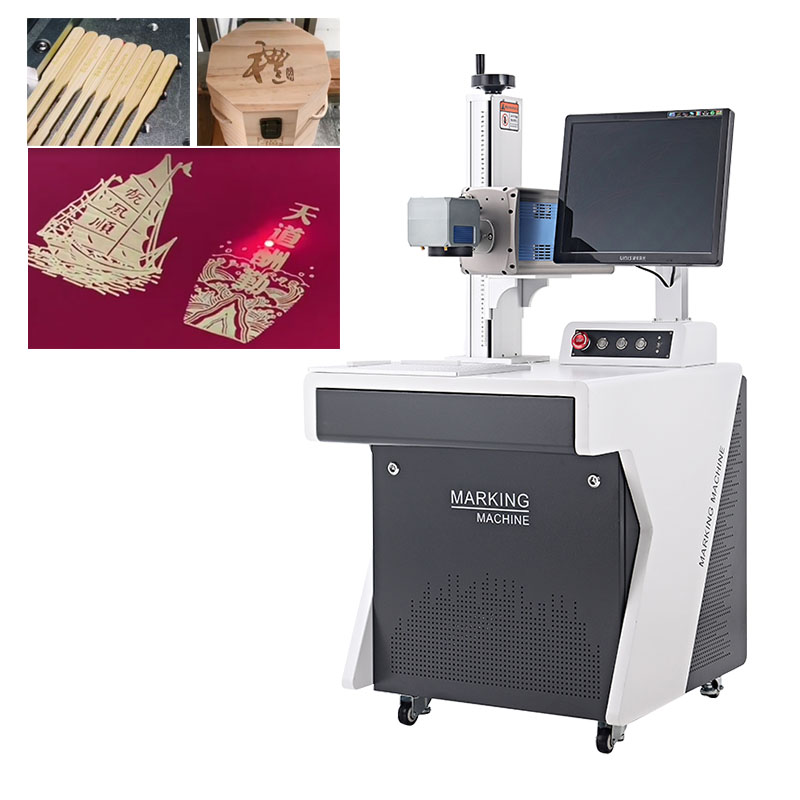
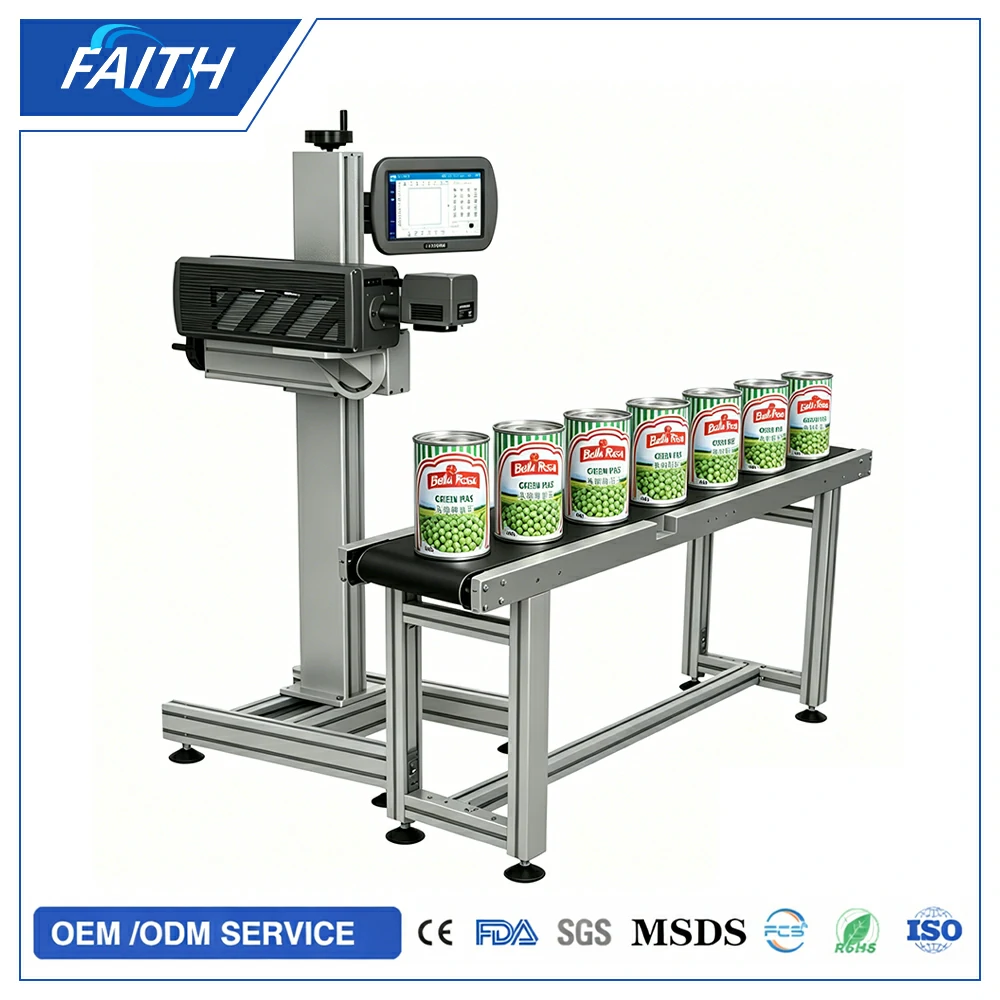
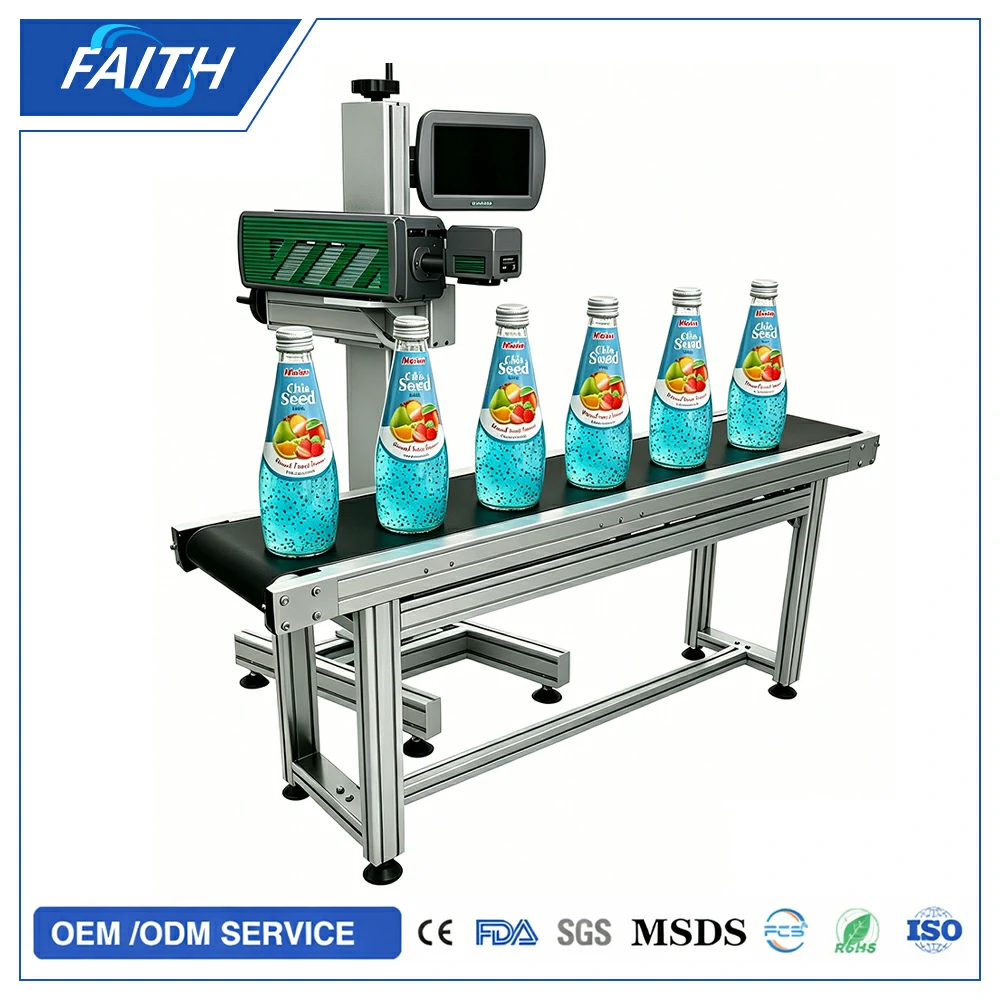
A flying laser marking machine is used on a moving production line. Products pass through the marking area on a conveyor, and the laser marks date codes, batch numbers, serial numbers, logos, barcodes or QR codes without stopping the product. It is not a desktop machine for manual marking one by one. It is designed for online production where speed, repeatability and clean coding matter.
In a typical packaging workshop, the machine may be installed beside a conveyor that is 800 mm to 1500 mm high. The laser marking head is fixed with an adjustable bracket, usually aimed at the side, top or bottom surface of the product. The control cabinet may be placed beside the line, while the marking head stays close to the moving product. The operator only needs to change the marking content from the screen or computer, such as production date, shift code, batch number or variable QR code.
The change from inkjet to laser usually starts with a cost problem.
Inkjet printers need ink, solvent, cartridges, filters and regular cleaning. In some factories, operators clean the nozzle every shift. In hot or dusty workshops, the nozzle blocks more often. If the production line uses plastic bags, paper boxes or bottles with uneven surfaces, the ink may spread, fade or rub off during transport. For export goods, this can become a quality complaint.
Laser marking does not use ink. The marking result is created directly on the material surface. On many packaging materials, the code becomes permanent and difficult to remove. For factories producing large quantities every day, the saving is not only from consumables. It also comes from fewer stops, less cleaning time and fewer rejected products.
One customer in the cable industry had another problem. Their old inkjet printer could print on cable jackets, but the code was not stable when the cable moved at high speed. Sometimes the characters were stretched. Sometimes the ink did not dry fast enough before the cable touched the guide wheel. The workshop smelled strongly of solvent, and workers did not like cleaning the printer after long shifts.
After switching to an online laser marking system, the marking stayed clear on the cable surface. The factory used it for meter marks, specification codes and production batch information. The cable diameter was not very large, but the line speed was high. The key point was not only whether the laser could mark the material, but whether the machine could receive the correct trigger signal and keep marking in the right position during continuous movement.
That is where many buyers need to pay attention.
When choosing a flying laser marking machine, the first question should not be “How many watts is it?” The first questions should be about the material, line speed, product size, marking area and coding content.
A small cosmetic bottle may only need a date code of 10 mm × 30 mm. A carton may need a larger QR code and batch number. A plastic pipe may require repeated marking every fixed distance. A medicine box may need clean characters without damaging the package surface. Different products require different laser sources, lenses and installation methods.
For metal caps, stainless steel parts, aluminum tags and some hard plastics, a fiber flying laser marking machine is often used. Fiber laser has strong marking ability on metal surfaces and can create clear serial numbers, logos and traceability codes. It is widely used in hardware, auto parts, electronics, bearings, tools and metal packaging.
For paper boxes, cartons, wood, leather, glass, acrylic, labels and some plastic films, a CO2 flying laser marking machine is more common. It works well in food packaging, beverage packaging, paper-based packaging and daily chemical products. Many factories use CO2 laser to replace inkjet coding for production date and expiry date on cartons or packaging films.
For materials that are sensitive to heat, such as cosmetic plastic bottles, medical packaging, PCB boards, electronic components, glass and some thin plastic materials, UV flying laser marking is often selected. UV laser creates a smaller heat-affected area, so it can reduce burning, yellowing or deformation. It is a good choice when the customer cares about fine marking quality and a clean appearance.
The installation environment also matters.
Some buyers only send a product photo and ask for a quotation. A responsible supplier will usually ask for more details: conveyor speed, product moving direction, available space, marking position, material sample, voltage, production line height and whether the factory already has a sensor or encoder. These details decide whether the machine can be installed smoothly.
A flying laser marking machine may look simple in a product photo, but real production lines are different. Some lines are narrow. Some conveyors vibrate. Some products are glossy and reflect light. Some bottles rotate slightly when moving. Some bags are soft and do not stay flat. If the machine is selected without checking these details, the marking effect may not match the buyer’s expectation.
Factories usually replace old coding equipment for practical reasons, not because they want a new machine.
They may be tired of buying ink every month. They may receive complaints about unclear batch numbers. They may want to reduce manual work. They may need a more stable solution for export packaging. Some buyers want to connect the coding machine with a packaging machine, filling machine, labeling machine or automatic conveyor system. In these cases, the flying laser marking machine becomes part of the whole production line, not just a separate device.
A good online laser marking solution should match the factory’s real workflow. The marking content should be easy to edit. The bracket should be stable. The focus distance should be easy to adjust. The sensor should trigger accurately. The marking head should be protected from dust, vibration and accidental impact. Operators should be able to change products without spending too much time.
For overseas B2B buyers, after-sales support is also important. Many factories do not have a laser engineer on site. They need clear installation guidance, video support, parameter setting help and sample testing before shipment. If the supplier can test the buyer’s real material before order confirmation, the risk becomes much lower.
Flying Laser marking machines are not suitable for every single product. Some low-volume workshops may still prefer a handheld printer or desktop marking machine. But for factories with continuous production, repeated coding, strict traceability and high consumable cost, online laser marking is becoming a practical upgrade.
The best machine is not always the highest power model. It is the one that can mark clearly on the customer’s material, keep up with the production speed, fit the available space and run every day without creating extra trouble for the operator.
That is what most factory buyers really care about.
Please leave the message you want to inquiry. We will reply you as soon as possible within 24 hours.
Please leave the message you want to inquiry. We will reply you as soon as possible within 24 hours.