

A purchasing manager from a surgical instrument factory once told us that their biggest problem was not production speed. It was traceability after sterilization.
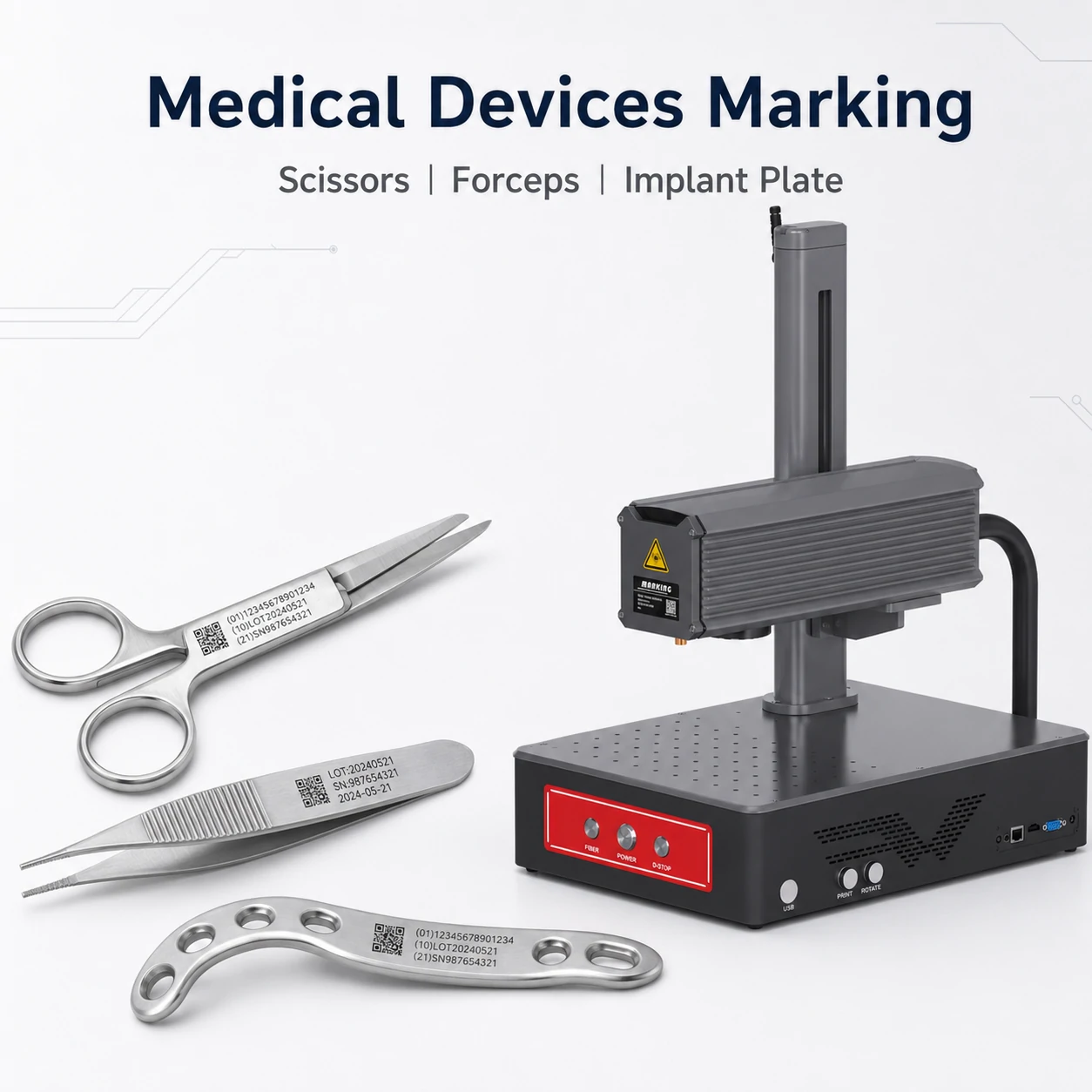
Their scissors, forceps and implant plates looked clean when they left the workshop. Each batch had a small printed label on the package, and the outer carton carried the production date and lot number. The system worked fine until hospitals started asking for direct part marking. Once the tool was separated from the package, the factory had no reliable way to keep the serial number with the product.
For medical devices, that is a serious issue.
Surgical scissors, dental tools, orthopedic plates, titanium implants and stainless-steel forceps often pass through cleaning, autoclave sterilization, alcohol wiping and repeated handling. Ink printing can fade. Stickers cannot stay on the metal surface. Mechanical engraving may leave rough edges if the operator does not control pressure well. Some factories still outsource engraving work, but that creates delays and makes small-batch orders difficult to manage.
A compact fiber Laser marking machine solves this problem in a more controlled way.
The desktop machine shown here is suitable for small and medium metal parts. It has a stable base, vertical lifting column and enclosed laser head structure. The marking table gives enough working space for flat medical plates, scissors handles, forceps and small nameplates. For workshops that do not have a large automatic line, this type of machine is easier to place near the inspection or packing area. The operator can mark the part, check the code, and move it to the next process without waiting for outside service.
Most medical device buyers care about three things: the mark must be clear, the size must be small enough for narrow parts, and the surface should not be damaged.
Fiber laser marking is commonly used on stainless steel, titanium alloy, aluminum and many coated metals. On a surgical scissor handle, the machine can mark a QR code, UDI code, serial number, batch number and production date. On an implant plate, the mark needs to stay readable but also avoid affecting the functional surface. That is where a stable laser source and proper parameter setting matter. A good supplier should not only sell the machine; they should test the customer’s sample and adjust power, speed and focus distance before shipment.
Many medical device factories start with one machine for sample testing or small-batch traceability. The machine may sit on a stainless-steel table in the clean workshop, next to a tray of tools waiting for final inspection. One worker can place the part into a simple fixture, press the start button, and finish the mark in a few seconds. The QR code can be checked by scanner immediately. If the code fails, the problem is found before packing.
This is much better than discovering unreadable codes after export.
Old marking methods often look cheaper at the beginning. Pneumatic dot peen marking can create deep marks, but it may not be suitable for all medical parts because of noise, vibration and surface deformation. Inkjet printing is fast, but it depends on ink adhesion and drying conditions. Labels are convenient, but they do not follow the product after cleaning or sterilization. For medical tools that need long-term identification, laser marking gives a cleaner and more permanent result.
Factories that export to Europe, North America and the Middle East are paying more attention to product traceability. Even when buyers do not mention “UDI” in the first inquiry, they usually ask whether the code can be scanned after cleaning. They may also send samples with very small marking areas, such as a narrow handle, curved forceps surface or tiny implant plate. In these cases, the machine supplier should ask for material, surface treatment, marking content, required code size and whether the part will go through sterilization.
A common mistake is choosing the laser power only by price. For most stainless-steel medical tools, 20W or 30W fiber laser systems can handle regular text, logo and QR code marking. If the customer needs faster speed, deeper engraving or marking on difficult coatings, higher power may be considered. But power alone does not decide the result. Lens size, focusing accuracy, software control and fixture design also affect the final mark.
For a factory buyer, the real value is not only the machine price. It is whether the supplier can help them reduce rejected parts and shorten the marking process.
A medical instrument workshop may process many models in one day. One order could be 500 surgical scissors with one batch number. The next order could be implant plates with different serial numbers. If the software supports variable data, QR codes and simple file changes, the operator can switch jobs quickly. That saves time and reduces manual typing errors.
The machine in the image is especially suitable for metal parts that require neat, flat positioning. The wide base keeps the machine stable during marking. The lifting column allows the operator to adjust the height for different part thicknesses. The front control buttons make operation simple for daily factory use. It is not a huge production line machine, but for traceability work, sample room marking, medical tool factories and metal part suppliers, this structure is practical.
When overseas buyers ask whether laser marking is suitable for their medical products, the best answer is usually based on samples. Send the material, part size, surface treatment and marking content. If possible, send a photo showing the exact marking position. A responsible supplier can test text, QR code and serial number before confirming the machine configuration.
In medical device production, a clear mark is not decoration. It is part of quality control.
A permanent code on a scissor, forceps or implant plate helps the factory track production, helps distributors manage stock, and helps hospitals identify products after use. For B2B buyers who are still using labels or outsourced engraving, a desktop fiber laser marking machine can make traceability easier, cleaner and more reliable inside their own workshop.
Please leave the message you want to inquiry. We will reply you as soon as possible within 24 hours.
Please leave the message you want to inquiry. We will reply you as soon as possible within 24 hours.