

For plastic bottle manufacturers, product marking is no longer just about printing a date. Today’s market demands clear traceability, food safety compliance, stable high-speed production, and lower long-term costs.
Many bottle factories are interested in laser marking technology, but also have common concerns:
This article answers these questions from a plastic bottle factory perspective, and explains how a properly selected laser marking system can become a reliable long-term solution.
This is the first and most important concern.
Plastic bottles are made from different materials, and laser performance depends heavily on material absorption characteristics.
Common Bottle Materials and Suitable Laser Types
👉 The key is not “one laser fits all”, but matching the laser source to your bottle material.
A professional manufacturer will always test your samples before final recommendation.
Laser marking is a non-contact and consumable-free process, which makes it highly suitable for food packaging.
Compared with inkjet printing:
Laser marking modifies the surface of the plastic itself, creating a permanent and food-safe mark.
For food and beverage factories, this means:
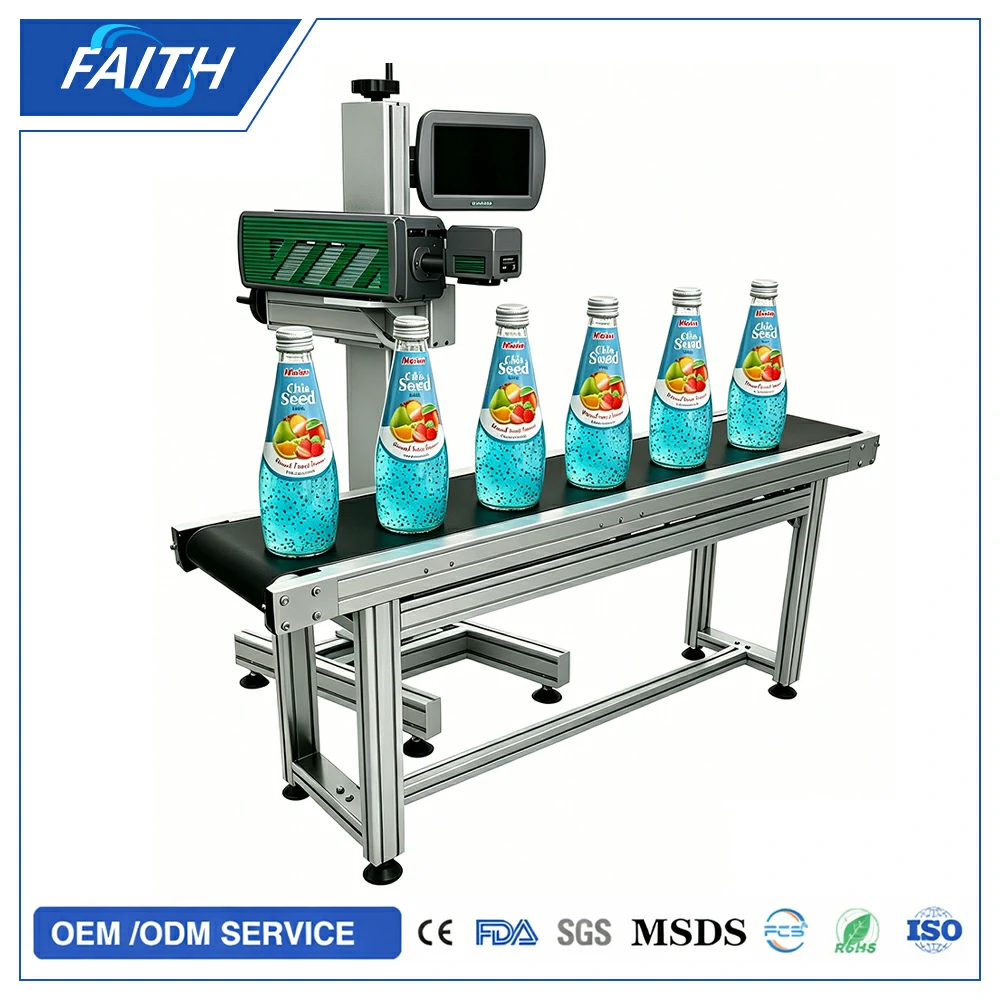
Modern laser marking systems are designed for on-the-fly (flying) marking, fully compatible with automatic filling and conveying lines.
Key capabilities include:
When properly configured, the laser system works synchronously with the conveyor, without stopping or slowing production.
👉 For most bottled water and beverage lines, CO₂ laser flying marking easily meets speed requirements.
Plastic bottles are cylindrical and often have uneven surfaces. This is another common concern.
Professional laser marking solutions address this by:
Whether marking on:
A well-configured system ensures consistent clarity and uniform depth.
At first glance, laser marking equipment has a higher initial cost than inkjet printers.
However, plastic bottle factories usually focus on long-term operation.
Laser marking advantages over time:
For medium- to high-volume bottle production, many factories find that laser marking pays for itself within a few years, while also improving marking quality and consistency.
Our laser marking systems are developed specifically for plastic bottle and packaging applications, focusing on:
Before any project, we:
Laser marking is not just a new technology—it is a production upgrade.
For plastic bottle manufacturers looking to:
A properly selected laser marking system offers a stable, clean, and future-proof solution.
If you are considering laser marking for your bottle production line, the most important step is choosing a manufacturer who understands plastic materials and real production conditions.
Please leave the message you want to inquiry. We will reply you as soon as possible within 24 hours.
Please leave the message you want to inquiry. We will reply you as soon as possible within 24 hours.