

A flying laser marking machine is usually needed when the marking process becomes the bottleneck of a production line. The factory may already have a conveyor, filling machine, sealing machine, labeling machine or automatic packaging line. Products keep moving, but the coding process still depends on ink, labels or an offline laser marking station. Workers need to stop the product, mark it, check it and put it back. At low production volume, this may still work. When the line speed increases, it becomes slow, expensive and unstable.
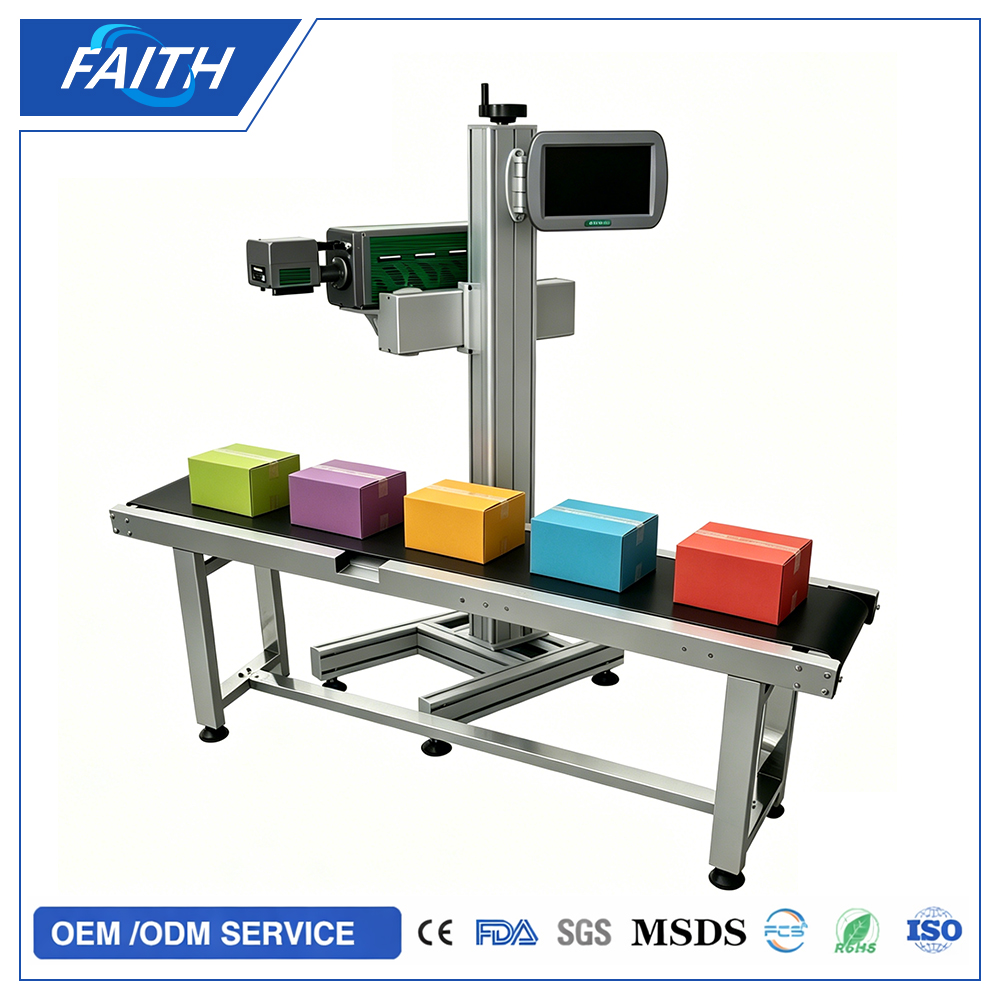
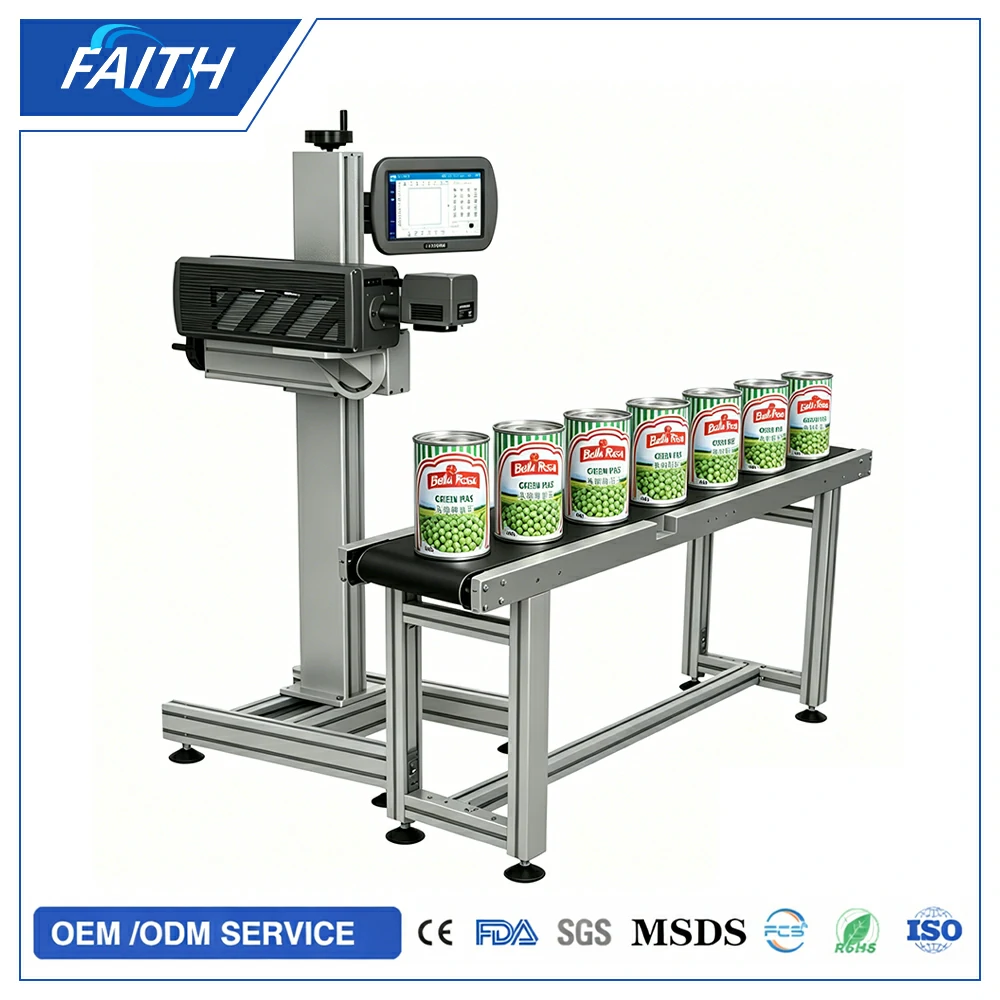
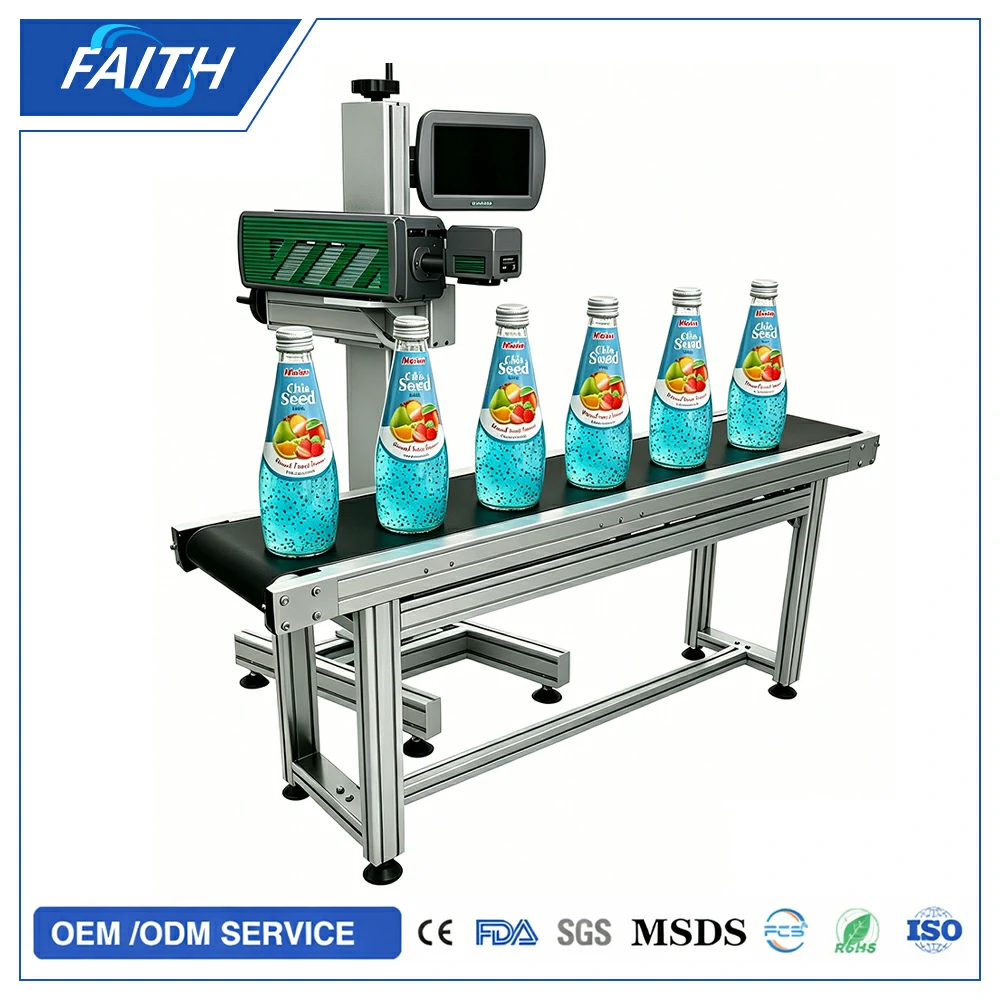
Flying laser marking means the laser marks the product while it is moving. It is commonly used for production dates, batch numbers, serial numbers, QR codes, barcodes, logos and traceability information. A complete flying laser marking system usually works with a conveyor, sensor and encoder. The sensor detects each product, the encoder tracks the line speed, and the laser marks at the correct position without stopping the product.
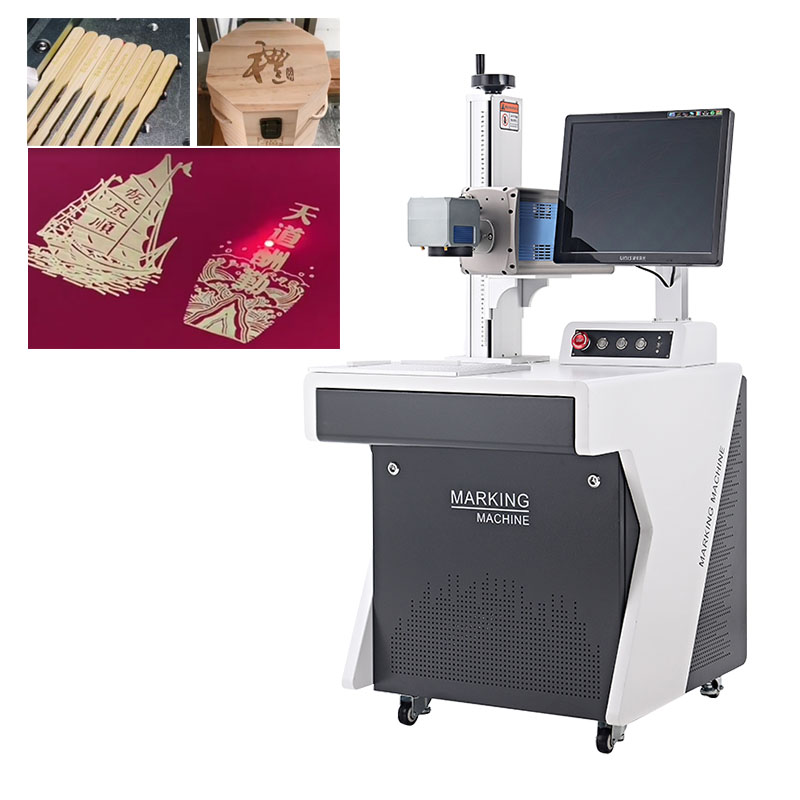
The first thing to confirm is the material. Different lasers are used for different products. A fiber flying laser marking machine is suitable for many metals and some hard plastics. A CO2 flying laser marking machine is suitable for paper, carton, wood, leather, rubber, glass, ceramic, coated packaging and many non-metal materials. A UV flying laser marking machine is often used for fine marking on plastics, glass, electronics, medical packaging and heat-sensitive materials. Buyers should not choose a flying laser only by power. The product material decides the laser type first.
In food and beverage packaging, CO2 flying laser marking is very common. It can mark date codes on paper boxes, plastic films, labels, bottle caps and outer cartons, depending on material testing. A snack factory may run small boxes on a conveyor at 40 meters per minute. A beverage factory may need to mark caps or labels at a much higher speed. If the current inkjet printer often blocks, or the ink does not dry well on glossy packaging, laser marking can reduce daily cleaning and line stoppage.
For metal parts and industrial components, fiber flying laser marking is more common. It can mark stainless steel, aluminum, tools, hardware, bearings, metal caps, electronic parts and some plastic components. A small metal part may pass under the laser every two seconds. The mark may only be 20 mm wide, but it must stay clear after oil cleaning, assembly, handling or long-term storage. In this situation, ink is usually not reliable enough, and labels may fall off or slow down production.
UV flying laser marking is used when heat damage is a concern. Some plastic packaging, medical tubes, electronic housings, cables and thin films can deform, burn or discolor with the wrong laser. UV laser creates a finer mark with less thermal effect. It is usually more expensive than CO2 or fiber laser, but for medical products, cosmetics packaging, electronics and high-value plastic parts, UV laser can be the safer choice. When the product surface is sensitive, mark quality is often more important than the lowest equipment cost.
Line speed is the second key point. A laser that marks well on a stationary sample may fail on a moving production line. The faster the conveyor runs, the less time the laser has to complete the code. Simple date codes are easier. Large logos, QR codes and dense barcodes take more marking time. If the product moves too fast, the mark may become stretched, incomplete or unreadable.
Before choosing the machine, the buyer should provide real production information: conveyor speed, product spacing, marking area, code size and marking content. A date code of 30 mm × 8 mm is very different from a 25 mm QR code with high data density. If the code needs to be scanned by a camera, warehouse scanner or mobile device, the supplier should test the scanning result at the required production speed.
Product shape also matters. Flat boxes are easier to mark than curved bottles. A stable carton moving on a belt is relatively simple. A round bottle may rotate slightly if the conveyor is not well designed. A pouch may wrinkle. A cable may shake. If the product is unstable, the laser cannot keep the marking position accurate. In many real production lines, the solution is not only the laser machine. Guiding rails, fixtures, pressing belts, spacing wheels or better conveyor control may also be needed.
The marking distance must remain stable. Laser marking has a focal distance. If the product height changes too much, the mark may become weak, blurred or uneven. For packaging lines that run different product sizes, the marking head may need height adjustment. Some factories use a lifting column with a ruler. Others need a more flexible bracket. If the production line changes products often, easy adjustment can save a lot of operator time.
Dust and smoke extraction should be considered from the beginning. Laser marking on paper, plastic, rubber, wood or coated materials can create smoke, dust or odor. Without proper extraction, the lens may become dirty and the marking quality may drop. Operators may also complain about smell. For many flying laser marking applications, a smoke extractor is not an optional accessory. It protects the lens, the machine and the working environment.
Software integration is another reason factories choose online laser marking systems. Some lines need automatic date change. Others need serial number counting, QR code generation, barcode marking, shift code or database connection. If the factory uses ERP or MES systems, the marking content may need to come from production orders. Not every buyer needs this function at the beginning, but it is better to confirm future requirements before purchasing.
Laser power should match the material, speed and marking content. For CO2 flying laser marking, 30W or 60W may be used depending on packaging material and line speed. For fiber flying laser marking, 20W, 30W or higher power may be selected for metal marking. UV systems often use lower power such as 3W, 5W or 10W, but the marking effect depends strongly on material absorption. Higher power is not always better. Too much power may burn packaging, deform plastic, damage coating or reduce code quality.
The working environment also affects machine selection. Some production lines run in clean rooms. Some are in dusty packaging workshops. Some are close to filling machines with moisture or oil mist. The flying laser marking system should have a stable bracket, suitable protection, reliable cooling and safe installation. For export buyers, voltage, language interface, safety labels, CE compliance, spare parts and after-sales support should also be checked before ordering.
Many factories replace inkjet printers with flying Laser marking machines because they want fewer consumables and less line stoppage. Inkjet printers are still useful for many products, but they require ink, solvent, cleaning and print head maintenance. Labeling systems need label rolls and applicator adjustment. Laser marking has a higher initial cost, but it does not need ink, solvent, ribbon or label consumables. For high-volume production lines, the running cost difference becomes clear after several months of operation.
A flying laser marking machine is not simply a laser source installed beside a conveyor. It is a production line solution. The supplier needs to understand product movement, speed, material, marking content, installation space and operator habits. A good test should use real samples moving at real speed. A clear photo is useful, but it is not enough. A video showing the product passing under the laser, together with scan results for QR codes or barcodes, gives a much better basis for decision.
For overseas B2B buyers, the safest way is to describe the whole production line, not only the product. Send the product size, material, conveyor photos, line speed, product spacing, marking position and current marking problem. The right flying laser marking machine should make the production line smoother, not create another difficult machine for operators to manage.
Please leave the message you want to inquiry. We will reply you as soon as possible within 24 hours.
Please leave the message you want to inquiry. We will reply you as soon as possible within 24 hours.