

Some products are too large, too heavy or too inconvenient to put under a desktop marking machine. A steel pipe may be 6 meters long. A welded frame may weigh more than 100 kg. A large mold, machine base, metal tank, flange or vehicle part cannot be moved easily just for marking. In these situations, the marking machine needs to go to the product, not the other way around. That is where a handheld laser marking machine becomes useful.
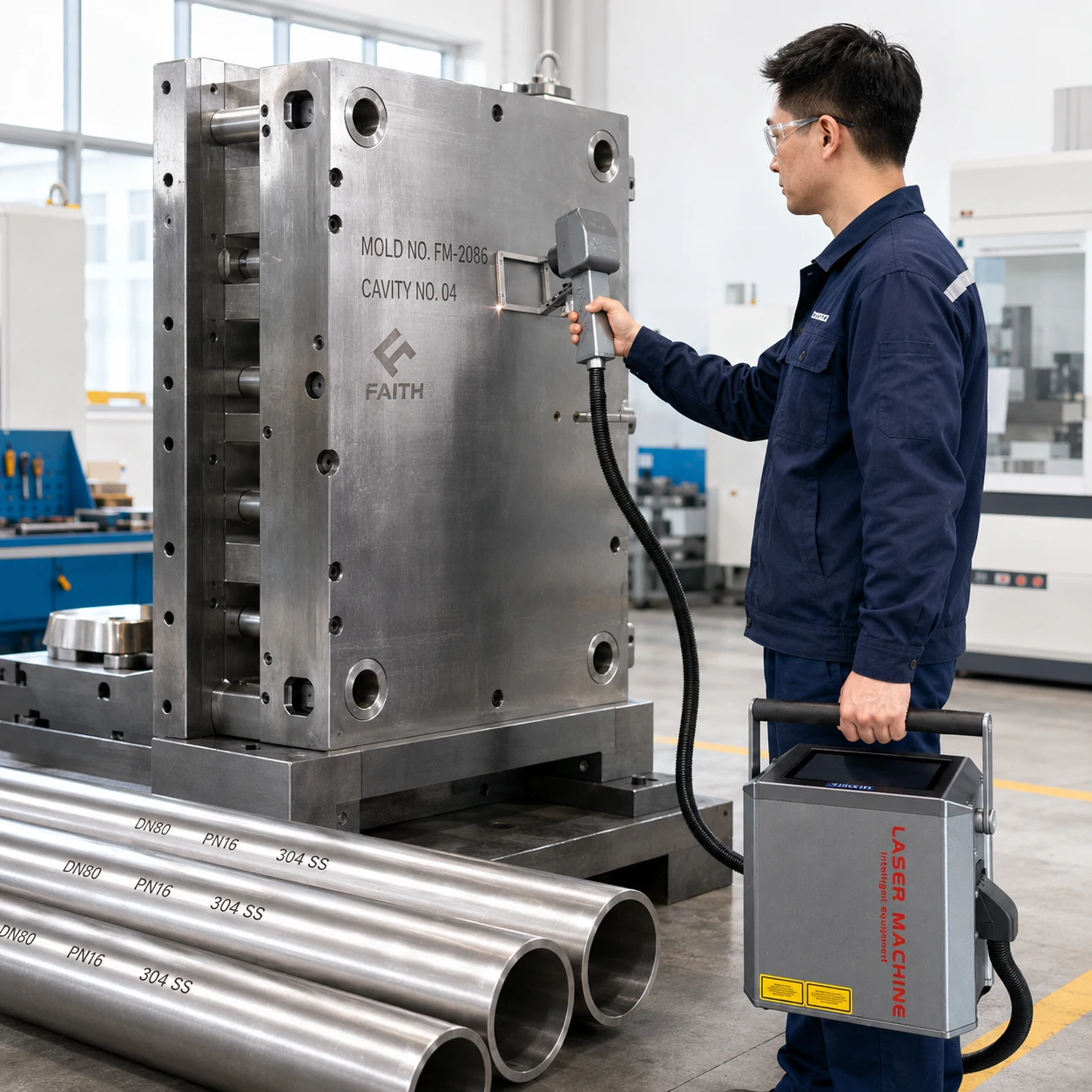
Many factories first try simple methods. Workers use metal tags, stickers, paint markers, hand stamps or portable engraving tools. These methods may work for temporary identification, but they are not always suitable for industrial traceability. Stickers fall off during transport or surface cleaning. Paint marks become unclear after outdoor storage. Hand stamping is noisy and depends heavily on operator skill. Manual engraving can be slow, uneven and difficult to repeat.
A handheld laser marking machine gives factories a more flexible way to create permanent marks on large or fixed products. It is commonly used for stainless steel, carbon steel, aluminum, galvanized parts, brass, copper, painted metal and some hard plastics, depending on the laser type and material. The marking content can include serial numbers, product models, batch codes, logos, QR codes, Data Matrix codes and inspection marks.
Metal pipe marking is a typical case. Pipe factories and steel stock suppliers often need to mark specifications, heat numbers, batch codes or customer information. Pipes may have different diameters, such as 20 mm, 50 mm, 100 mm or larger. The length may be several meters, and the weight can make manual handling difficult. Moving each pipe to a fixed marking station wastes time and increases labor. A handheld laser can mark directly on the pipe surface after cutting, inspection or bundling.
The curved surface needs attention. If the marking area is too large, the focus may change from one side to the other. For small text or a narrow code, this is usually manageable. For a large logo on a small-diameter pipe, the result may not be perfect unless a rotary fixture or special setup is used. Buyers should test the actual pipe diameter and required code size before deciding.
Large metal fabrication is another common field. Factories producing steel structures, machinery frames, welded parts, plates and custom components often need part numbers for assembly. A worker may need to mark a 1.5-meter steel plate, a welded bracket or a heavy base after inspection. If the part is already on a pallet or inside a work area, moving it to a marking table is not practical. A handheld laser reduces handling and helps workers mark at the correct stage of production.
Automotive and machinery repair workshops also use handheld laser marking for engine parts, chassis components, tools and replacement parts. The mark can help identify the repair batch, service date or part source. In some industries, traceability is not only for production but also for maintenance. A clear mark on the part itself is easier to manage than paper records alone.
Compared with handheld dot peen marking, handheld laser marking is quieter and does not physically strike the material. This is useful for parts that should not be deformed. The mark can be fine and clean, especially on stainless steel and aluminum. It can also create QR codes and logos with better detail. However, laser marking needs proper eye protection, safety operation and correct focus. It is not a casual tool that should be used without training.
The weight and structure of the handheld marking head are important. Operators may hold the head many times a day. If the head is too heavy, marking becomes tiring and position accuracy drops. Some handheld heads are designed with support frames or positioning plates to keep a stable distance from the surface. This helps maintain focus and makes the mark more consistent. For vertical surfaces or overhead marking, ergonomics becomes even more important.
Power selection depends on material and marking requirement. A 20W or 30W fiber laser may be enough for many metal marking jobs. Higher power can improve speed or create deeper marks, but it may also increase cost and heat effect. For most traceability marks on stainless steel, aluminum and carbon steel, the buyer should focus on mark clarity, speed and stability rather than simply asking for the highest power.
The marking area is another practical detail. Many handheld laser machines use a marking field such as 70 mm × 70 mm, 110 mm × 110 mm or similar sizes. A small field gives better detail. A larger field can mark bigger logos or longer text, but the operator must keep the head stable across the whole area. If the factory mainly marks serial numbers and small QR codes, a standard field is usually enough. If large logos are needed, testing is necessary.
Outdoor or on-site work requires more planning. The machine may need to be moved between workshop areas, production lines or customer sites. Buyers should check the machine size, cable length, cooling method, power supply and protective case. A portable machine is not only about the handheld head. The whole system should be easy to transport and set up. If the main cabinet is heavy or the cables are too short, daily use becomes inconvenient.
Surface condition affects the mark. Rust, oil, dust, paint and scale can change the result. A clean metal surface gives the best marking quality. If the part has oil or heavy rust, workers may need to wipe or grind the marking area first. For painted metal, laser can remove the paint layer and expose the base material, but the result depends on coating thickness and color. For galvanized steel, the mark can be clear, but parameters should be tested to avoid excessive damage to the coating.
Handheld laser marking is used in steel pipe factories, metal fabrication, automotive parts, hardware tools, machinery manufacturing, mold workshops, shipbuilding, construction steel, electrical cabinets and large equipment production. The common point is simple: the product is difficult to move, but the mark must be permanent and professional.
For B2B buyers, the best selection process starts with real working conditions. How large and heavy are the products? Where is the marking position? Is the surface flat, curved, painted or rusty? What code size is needed? How many pieces are marked per day? Does the operator move around the workshop? These details are more useful than only asking for price.
A handheld laser marking machine can save labor and improve traceability when the application is correct. It is not meant to replace every desktop machine or every online laser. It is most valuable when flexibility matters: large parts, fixed products, small batches, changing positions and on-site marking. With proper sample testing and safety training, it becomes a practical tool for factories that need permanent marks without moving heavy products.
Please leave the message you want to inquiry. We will reply you as soon as possible within 24 hours.
Please leave the message you want to inquiry. We will reply you as soon as possible within 24 hours.