

As the wave of Industry 4.0 sweeps the globe, efficiency, precision, and green manufacturing have become core keywords for upgrading the manufacturing industry. In the high-speed operation of assembly lines, the bottlenecks of traditional marking methods are becoming increasingly apparent: time-consuming and labor-intensive positioning during downtime, blurry and easily worn marks, high material consumption, and continuously rising labor costs… A revolution in marking technology is quietly taking place, and Flying laser marking machines are the core drivers of this revolution. Using light as a pen and intelligence as its soul, they dynamically engrave quality and empower production with high efficiency.
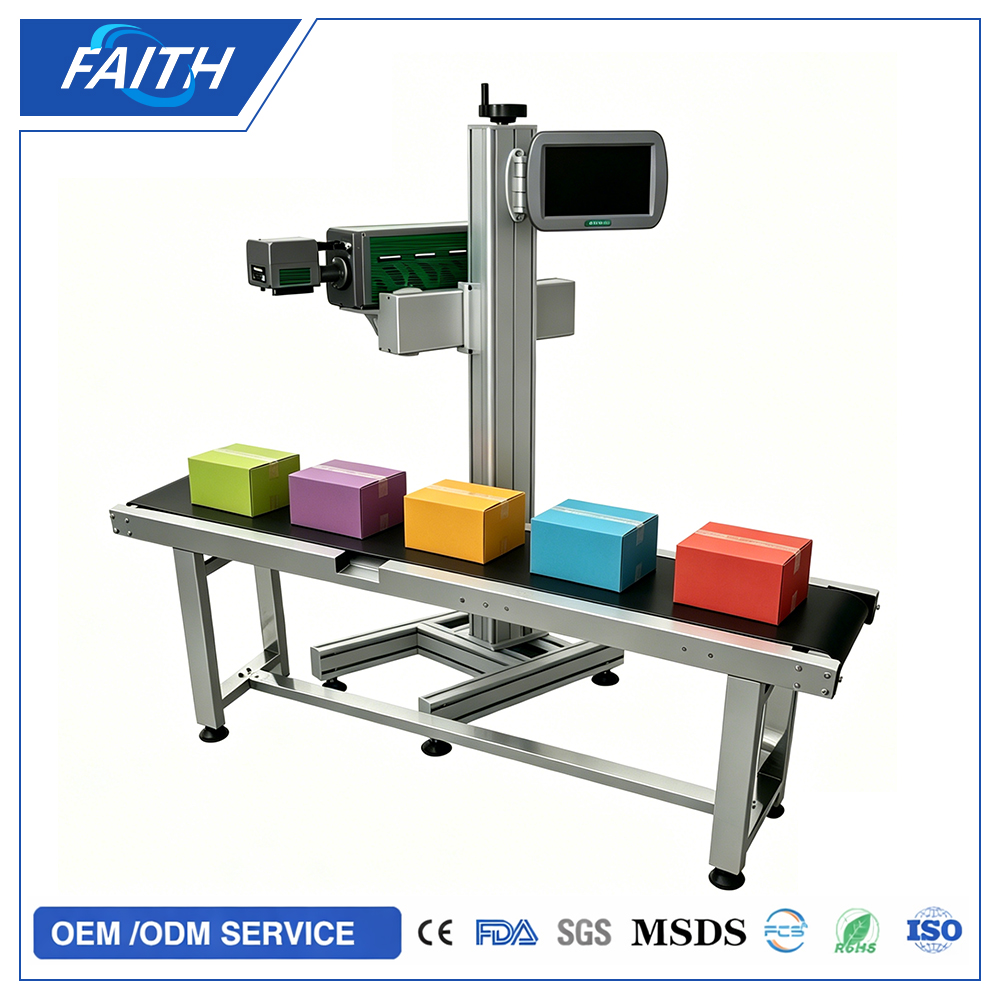
Unlike the limitations of traditional static laser marking machines that require "marking on the line," the core breakthrough of flying laser marking machines is "dynamic tracking"—it does not require interrupting the assembly line operation and can achieve real-time, continuous, and precise marking while products are moving at high speed. This allows production rhythm and marking efficiency to resonate in unison, completely breaking the industry dilemma of "efficiency and precision being mutually exclusive." Behind this lies the perfect integration of a high-speed galvanometer scanning system and intelligent control algorithms. By capturing workpiece movement signals through sensors and receiving real-time speed feedback from the encoder, the control system synchronously adjusts laser parameters at millisecond levels. Even at a high marking speed of 7000mm/s, it ensures clear and uniform markings, with a minimum character size of 0.1mm and a repeatability as low as 0.01mm, making every mark a testament to quality.
In the race for intelligent manufacturing, the advantages of flying laser marking machines go far beyond "high speed and precision." As a non-contact processing device, it avoids direct contact with the workpiece, completely eliminating product deformation and damage caused by mechanical wear. It is particularly suitable for marking sensitive products such as electronic components and precision parts, truly achieving "zero-damage" processing. Compared to traditional methods like inkjet and pad printing, laser marking eliminates the need for consumables such as ink and solvents, thus avoiding chemical pollution and aligning with green manufacturing principles. It also significantly reduces operating costs for businesses, resulting in substantial long-term savings on consumables. Furthermore, laser marking produces wear-resistant, corrosion-resistant, and fade-resistant marks that can withstand extreme environments. This meets the stringent durability requirements of industries like automotive and aerospace, while also enabling tamper-proof marking for product traceability throughout its entire lifecycle, providing robust protection against counterfeiting and cross-selling.
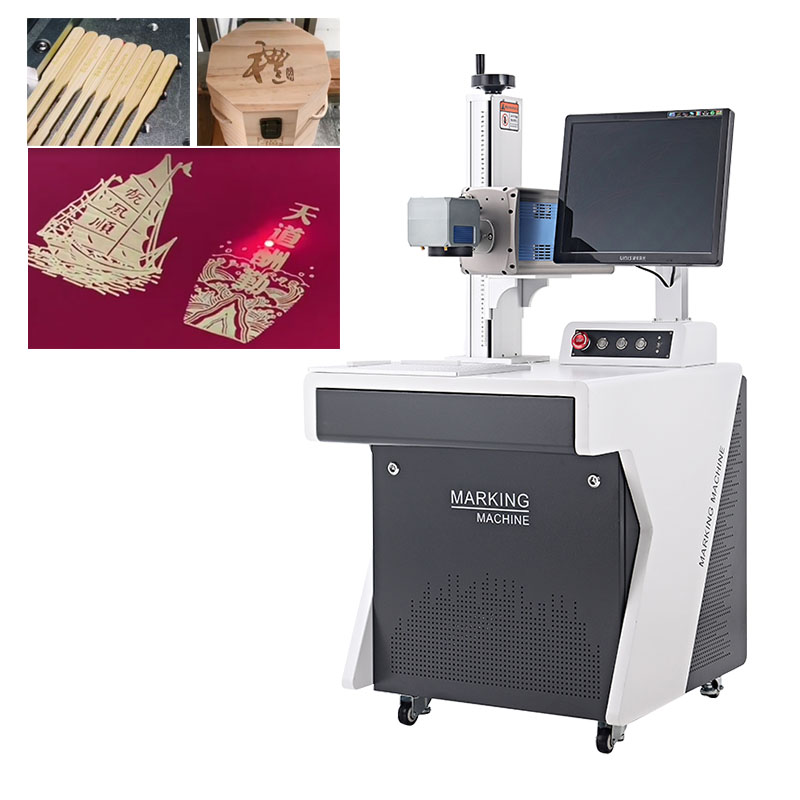
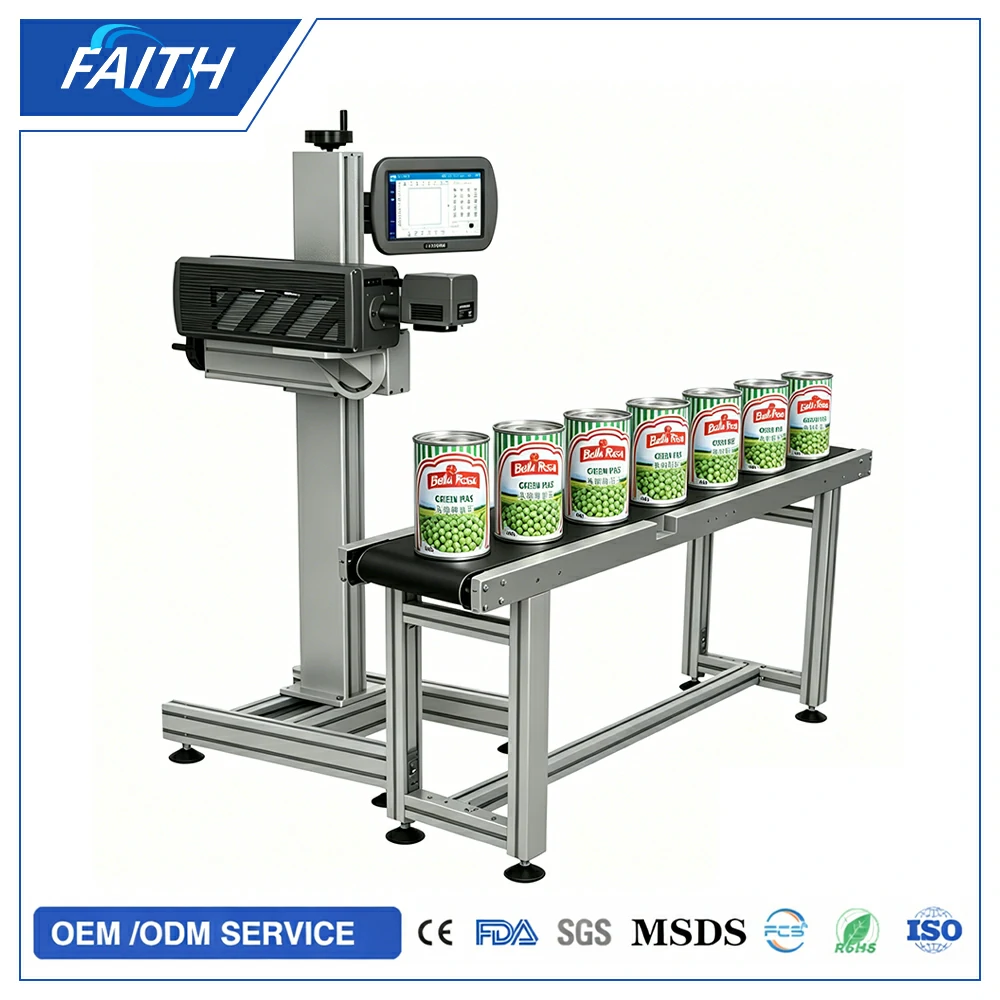
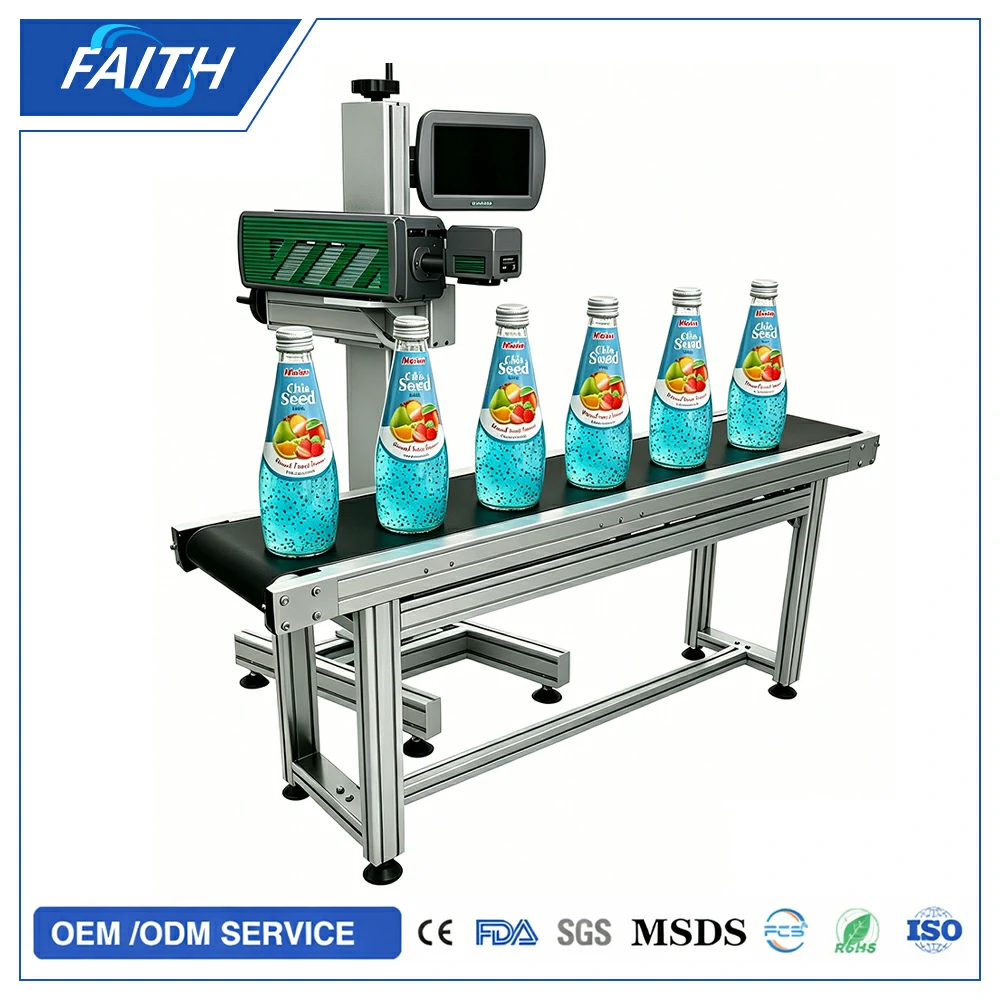
From factory assembly lines to industry-wide applications, flying laser marking machines have permeated every aspect of our production and daily lives, becoming a crucial link between products and quality, and between production and intelligence. In the food and beverage industry, it quickly marks production dates, batch numbers, and QR codes on bottles and packaging boxes during high-speed transport, ensuring food safety traceability and meeting industry compliance requirements. In the pharmaceutical field, it accurately marks drug dosages and serial numbers, with non-contact processing avoiding secondary contamination and safeguarding medication safety. In the electronics industry, it engraves serial numbers and QR codes on tiny chips and PCBs without damaging sensitive components, aiding in product inventory management and quality control. In the automotive manufacturing industry, it marks engines and parts along the production line, providing clear and durable markings to meet the needs of full lifecycle traceability for automotive parts, and has even become a core component of production lines for well-known companies like Tesla. In industries such as pipes, daily chemicals, and handicrafts, its flexible marking capabilities adapt to various materials such as metal, plastic, ceramics, and leather, supporting text, patterns, and variable serial numbers, easily meeting the personalized marking needs of enterprises.
Today, the manufacturing industry is transforming from "extensive production" to "refined and intelligent production," and the core competitiveness of enterprises has long since shifted from "scale" to "efficiency" and "quality." Flying laser marking machines are more than just marking equipment; they are powerful tools for enterprises to reduce costs, increase efficiency, and enhance core competitiveness. They require no dedicated personnel and seamlessly integrate with intelligent systems such as MES and ERP, achieving fully automated online marking and significantly reducing manual labor. Their compact structure and easy installation allow for flexible integration into existing production lines without large-scale workshop layout modifications. Supporting visual positioning, they automatically identify and correct workpiece positions, ensuring marking accuracy even with slight workpiece misalignment, further lowering the barrier to manual operation.
From "can mark" to "intelligent marking," from "static processing" to "dynamic tracking," the iterative upgrades of flying laser marking machines are a microcosm of intelligent manufacturing development. Using light as a medium, they break the boundaries of traditional production; empowered by intelligence, they reconstruct the paradigm of efficient production; and based on quality, they safeguard the bottom line of quality for every product. In today's pursuit of efficiency and quality, choosing a high-quality flying laser marking machine is not only choosing a more efficient and environmentally friendly marking method, but also choosing an upgrade path that aligns with the trends of the times.
Light and shadow follow, creating the future with intelligence. Flying laser marking machines, with their precise beams, high efficiency, and wide range of applications, are empowering the transformation and upgrading of various industries, witnessing the birth of every product, and engraving every promise of quality. As technology and production deeply integrate, and efficiency and quality move in tandem, flying laser marking machines will continue to use light as their pen, accelerating forward and writing a new chapter in intelligent manufacturing, helping more enterprises seize opportunities and win the future in the tide of the times.
Please leave the message you want to inquiry. We will reply you as soon as possible within 24 hours.
Please leave the message you want to inquiry. We will reply you as soon as possible within 24 hours.