

On the assembly line of a modern factory, time is cost, and efficiency is life. Imagine tens of thousands of products flowing at high speed on a conveyor belt—how can each product be clearly and permanently marked with its production date, batch number, or QR code without requiring it to "stop" even for a moment? The answer is the protagonist of this article—the Flying laser marking machine.
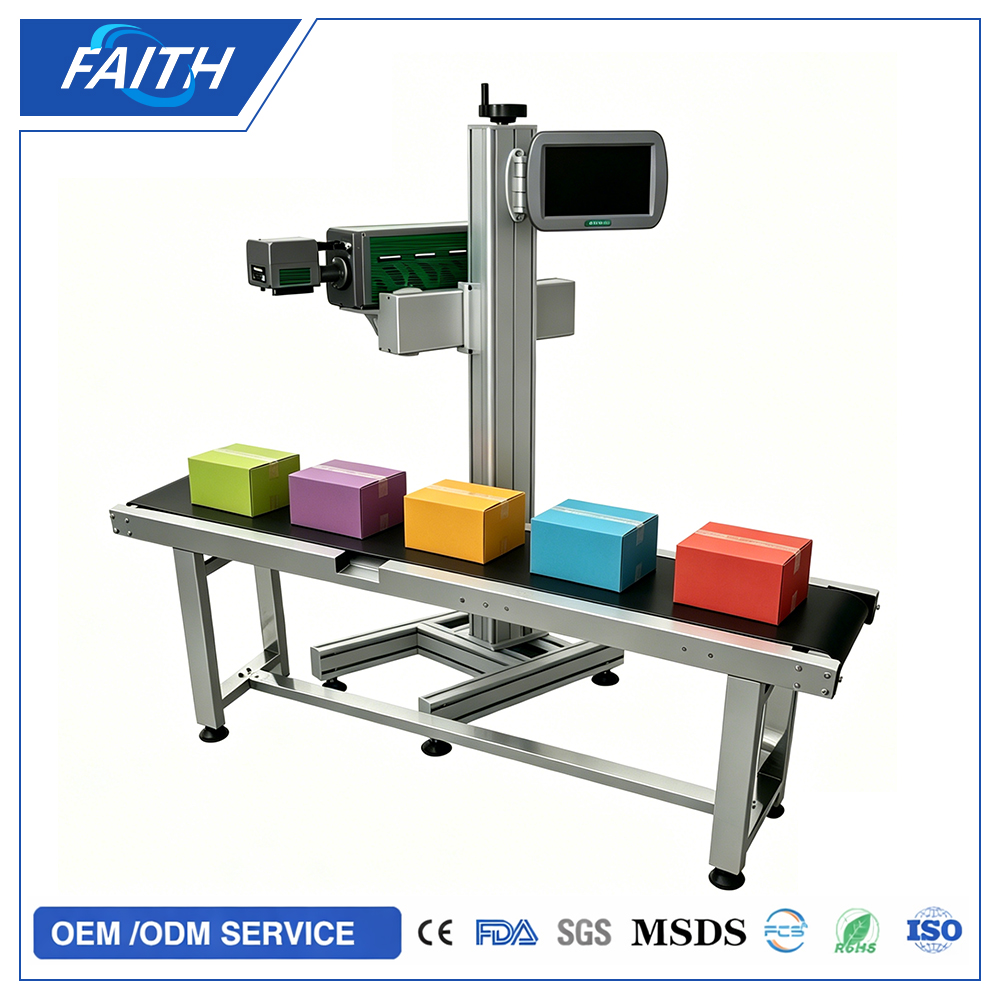
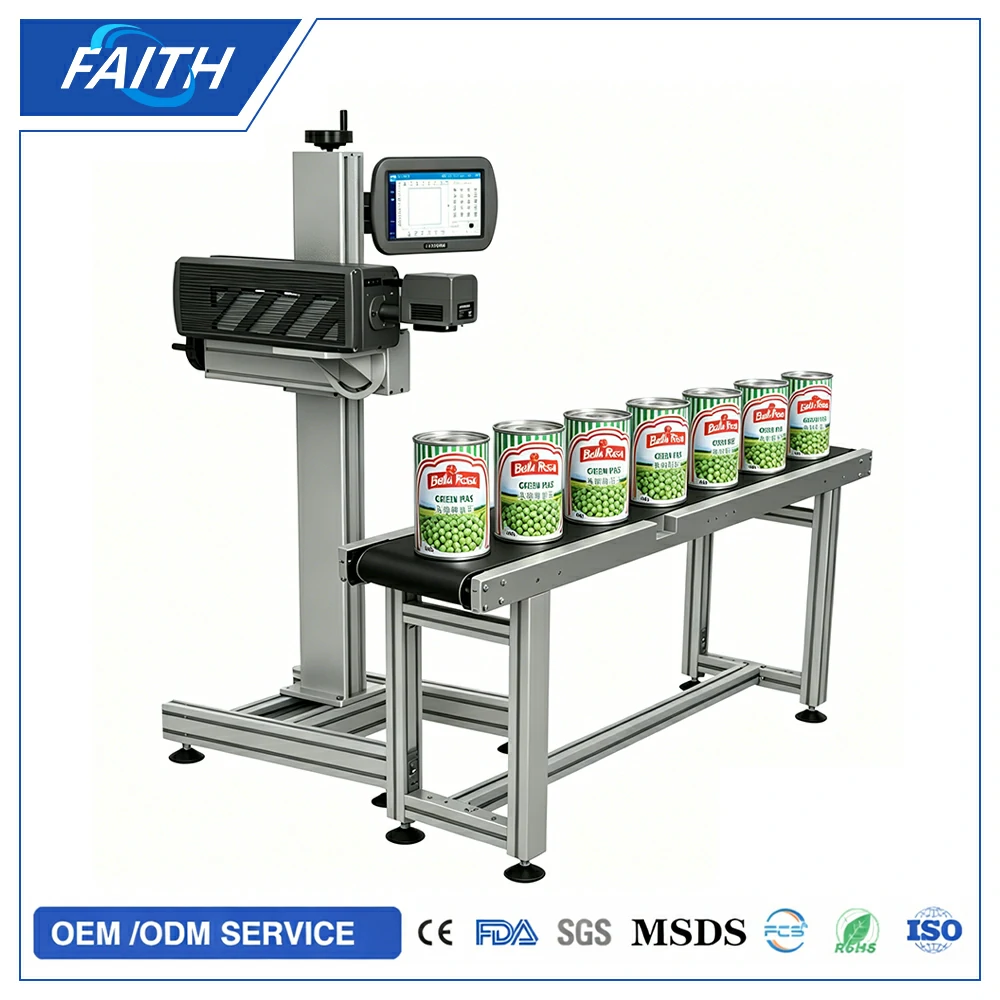
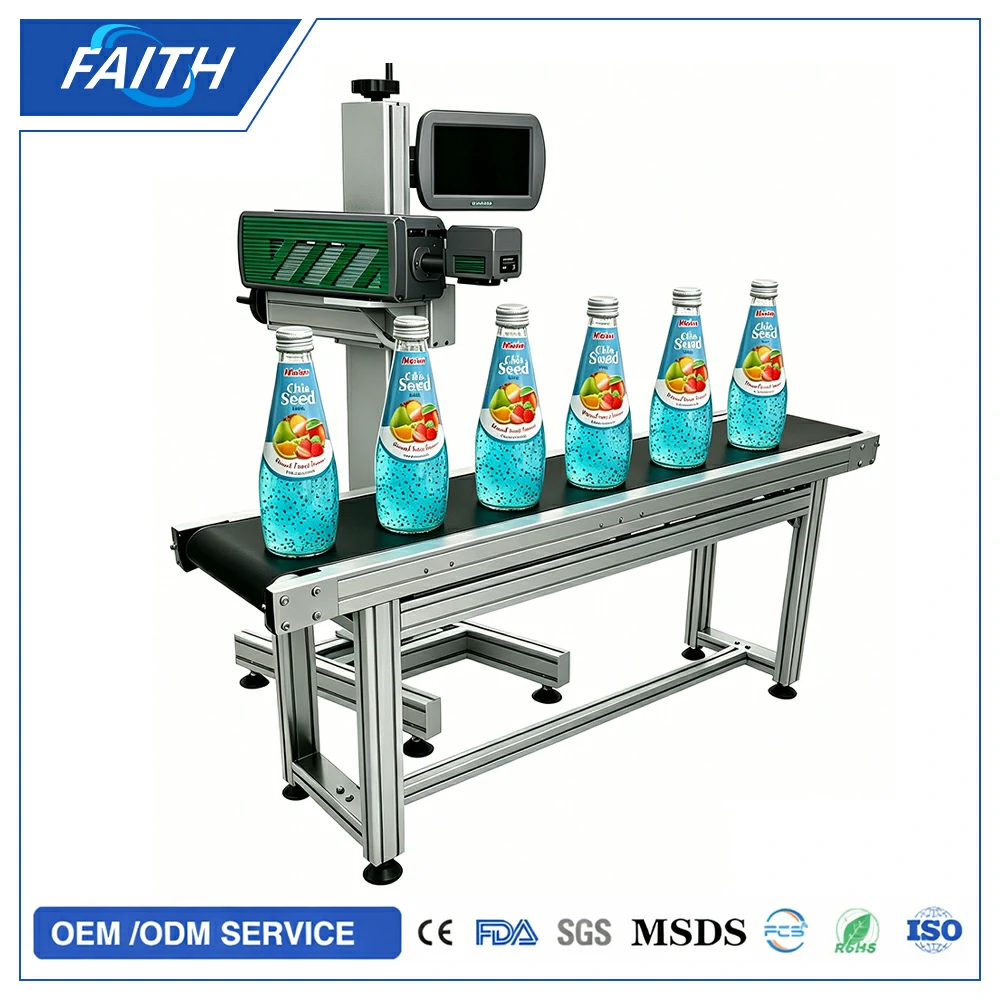
The flying laser marking machine, also known as an in-line laser marking machine, is a high-efficiency marking device specifically designed for assembly lines. It breaks the limitation of traditional Laser marking machines that require the workpiece to be stationary, enabling precise marking during continuous product movement. It has become an indispensable part of automated production in many industries such as food and beverage, pharmaceuticals, electronics, and tobacco.
What is Flying Laser Marking? Principles and Core Mechanisms
The core principle of flying laser marking lies in dynamic compensation. Its working principle is not fundamentally different from that of traditional static laser marking machines; the biggest difference lies in the drive software and control logic.
In a flying marking system, an encoder, a key component, is usually built into the production line. The system activates immediately when the sensor detects the product has reached the marking position. The encoder monitors the production line's speed in real time and continuously transmits data to the laser controller. At this point, the laser beam, controlled by the scanning galvanometer, not only completes the pre-designed graphic trajectory but also incorporates a compensation component that matches the speed and direction of the production line's movement.
Simply put, as the workpiece moves forward at speed V1, the laser spot also "chases" the workpiece at the same speed V1 along the X-axis (production line direction) to mark it. Through this precise dynamic compensation, a clear, distortion-free mark is achieved on the surface of the high-speed moving workpiece, as if it were marked while stationary.
Core Advantages: Why Choose Flying Laser Marking?
Flying laser marking machines are highly favored due to their significant advantages over traditional inkjet printers or static marking machines: Extreme Efficiency, Seamless Integration: It enables online marking during product flow without interrupting the conveyor belt. This not only optimizes the production process but also significantly increases the production line's throughput, achieving several times the capacity of static marking machines, perfectly matching the industrial demands of high-volume, high-speed production.
Permanent Marking, Anti-counterfeiting and Traceability: Laser marking involves physical/chemical alteration, ensuring the marking is permanent and will not fade or blur due to time, temperature, or friction. This characteristic gives it a natural advantage in product anti-counterfeiting, anti-counterfeiting, and quality traceability.
Extremely Low Operating Costs: Compared to inkjet printers, which require frequent purchases of ink and solvents and are prone to nozzle clogging, flying laser marking machines operate with "no consumables." They have virtually no easily damaged parts, are simple to maintain, and can save companies considerable costs in the long run.
Environmentally Friendly and Clean: The laser processing process is non-toxic, harmless, and produces no chemical pollutants, making it an environmentally friendly green processing technology, especially suitable for the food and pharmaceutical industries with extremely high hygiene requirements.
Diverse Laser Sources and Application Scenarios: Flying laser marking machines are not a single product. Depending on the laser source used, they can be divided into several types to meet the needs of different materials and industries:
Fiber Optic Flying Laser Marking Machine: Primarily used for metals and some non-metals, such as electronic products, automotive parts, and pipes, it can mark serial numbers, QR codes, etc.
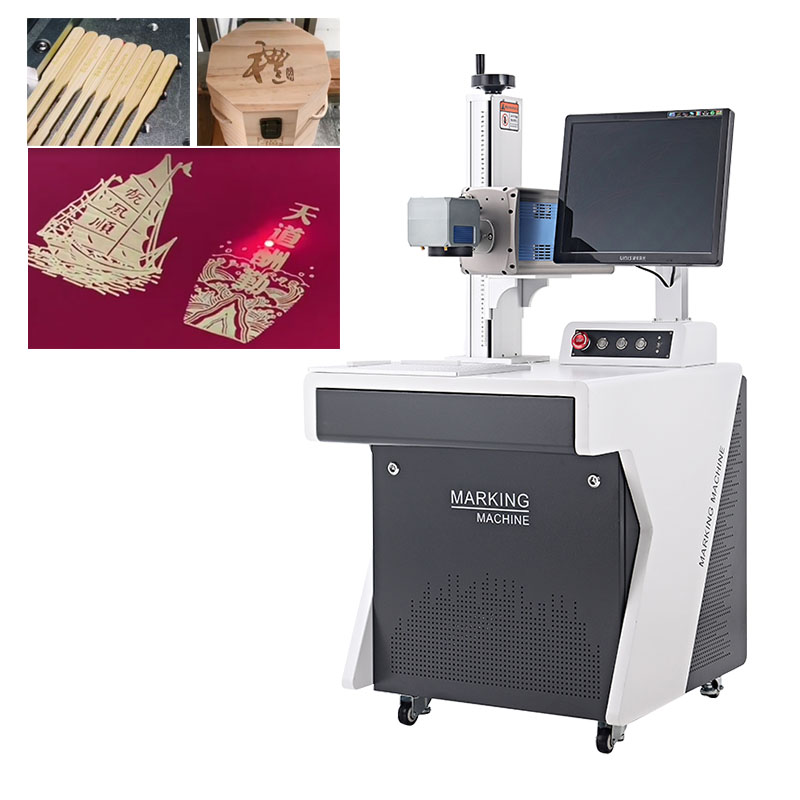
CO₂ flying laser marking machine: Suitable for non-metallic materials such as paper packaging boxes, plastic bottles, PET film, wood, and leather. Its most common application is marking production dates and batch numbers on the outer packaging of food, pharmaceuticals, tobacco, and beverages.
UV flying laser marking machine: Employs a "cold processing" principle, resulting in a minimal heat-affected zone and extremely high precision. It is particularly suitable for heat-sensitive materials such as high-end cosmetic packaging, pharmaceutical blister packs, flexible circuit boards, glass, and ceramics.
Technological Evolution: From Two-Dimensional to Three-Dimensional Dynamic Marking
With the development of Industry 4.0 and intelligent manufacturing, flying laser marking technology is constantly making breakthroughs. Traditional flying laser marking is mainly for planar or regular curved surfaces (such as cylindrical surfaces). However, ensuring the accuracy and continuity of marking during dynamic flight has always been a major challenge for irregular workpieces with complex shapes and varied curvatures.
The emergence of flying laser marking machines not only resolves the contradiction between traditional static processing and modern production lines but also redefines the standard for online marking with its high efficiency, precision, stability, and environmental friendliness. From dates on everyday beverage bottle caps to miniature QR codes on precision electronic components, flying laser marking technology is silently identifying each product, safeguarding the last line of defense for product quality, safety, and brand reputation. In the future, with further technological advancements and cost reductions, this high-speed marking technology will demonstrate its unique value in even more fields.
Please leave the message you want to inquiry. We will reply you as soon as possible within 24 hours.
Please leave the message you want to inquiry. We will reply you as soon as possible within 24 hours.