

In many metal parts factories, the marking problem does not look serious at the beginning. A worker writes a batch number on the surface with a marker pen. Another one sticks a label on the box. For small orders, it may work for a while. But when the customer starts asking for traceability, permanent serial numbers, QR codes, or anti-counterfeit marks, the old method quickly becomes a weak point in production.
A hardware factory may process thousands of stainless steel fittings every week. Some parts are small, some are oily, and some have curved surfaces. Labels do not stay well on metal, especially when parts go through handling, cleaning, or long-distance shipping. Ink printing can fade after friction. Mechanical engraving is slow and noisy, and it often needs skilled workers to adjust the depth and position again and again.
This is one of the common reasons buyers start looking for a Fiber laser marking machine.
Fiber laser marking is mainly used for metal materials such as stainless steel, aluminum, carbon steel, brass, copper, iron, coated metal, tools, bearings, gears, nameplates, auto parts, electronic shells, and machinery components. The mark is not a sticker or a surface coating. It is made directly on the material surface, so it is more suitable for parts that need long-term identification.
In a typical workshop, the operator may need to mark part numbers, production dates, brand logos, serial codes, QR codes, or simple graphics. If the factory exports products, the marking must stay clear after packing, shipping, customs inspection, and customer assembly. A blurred code can create trouble later, especially for machinery parts, automotive components, valves, flanges, tools, and spare parts.
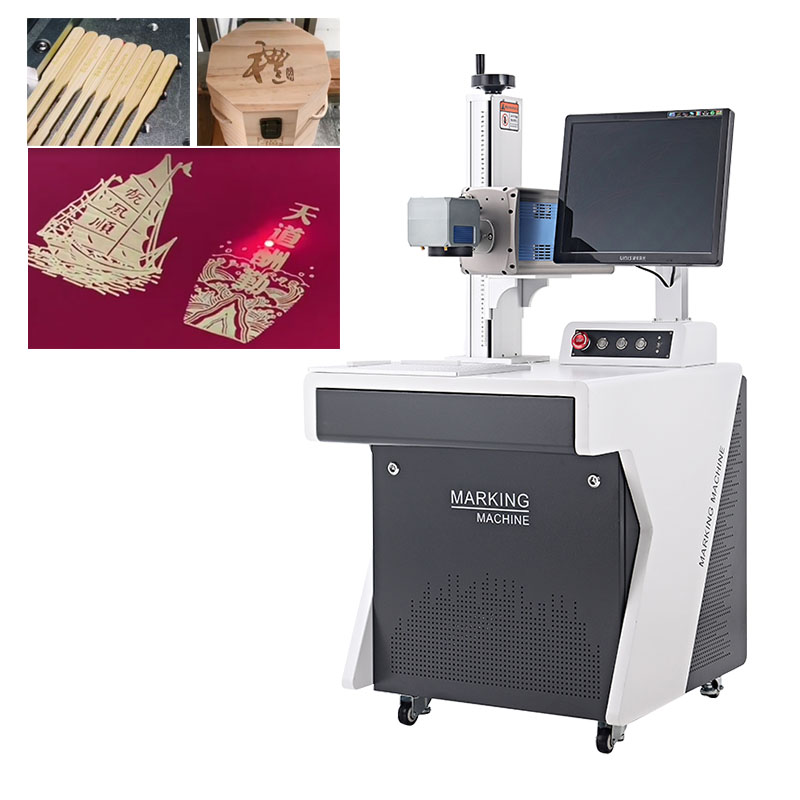
A compact desktop fiber laser marking machine is often enough for small and medium factories. The machine can be placed on a workbench instead of occupying a full production area. For many buyers, this is important because their workshop already has CNC machines, cutting tables, polishing machines, inspection tables, and packing stations. They do not want a large machine that blocks the working path.
The usual marking area of many desktop fiber laser machines is around 110×110 mm, which is enough for most nameplates, tools, metal tags, small parts, electrical components, and accessories. For larger parts, the supplier can usually recommend a different lens or working table. Buyers should not only ask for power. They should also confirm the marking size, material, depth requirement, code size, and whether the part surface is flat, curved, painted, or anodized.
Power selection also depends on the job. A 20W or 30W fiber laser marking machine is commonly used for logos, serial numbers, and surface marking. A 50W machine is better when the customer needs faster marking, deeper engraving, or more stable work on harder metal. Some factories choose higher power when they mark tools, molds, thick nameplates, or parts that require deeper contrast.
In real use, the machine is usually not difficult to operate, but the first setup matters. The operator needs to learn how to adjust focus, import artwork, set marking speed, choose power, and test the result on waste material. A good sample test before shipment can save a lot of time. Many problems do not come from the machine itself, but from wrong parameter settings or unclear material information.
For example, stainless steel, aluminum, brass, and coated metal may all need different settings. Even two aluminum parts can react differently if one is anodized and another one is raw aluminum. A buyer who sends sample photos, material details, and marking content before ordering usually gets a better result than a buyer who only asks for the lowest price.
Factories change to fiber laser marking not only because the mark looks clean. They also want to reduce labor. One worker can operate the machine, load the part, click marking, and continue with the next piece. If the product is fixed with a simple jig, the position becomes more stable. This is very useful for batch production, especially when the same part needs the same mark every day.
For distributors, fiber Laser marking machines are also easier to promote because the application range is wide. Metal parts exist in almost every market: automotive repair, hardware production, metal fabrication, machinery, electronics, tools, kitchenware, gift customization, and industrial nameplates. A reseller can sell the same basic machine to different industries by changing the sample demonstration.
Still, buyers should be careful with unrealistic promises. A fiber laser marking machine is powerful, but it is not the best choice for every material. It is excellent for most metals and some hard plastics, but not the best solution for wood, paper, leather, or many organic materials. Those materials usually need a CO2 laser. For glass or sensitive plastic packaging, UV laser may perform better.
A professional supplier should help the buyer choose the right laser source instead of pushing only one model. The best machine is not always the most expensive one. It is the machine that matches the material, marking content, production speed, and factory layout.
For a factory that still uses labels, ink stamps, or manual engraving on metal parts, fiber laser marking is often a practical upgrade. It gives the product a cleaner appearance, makes traceability easier, and reduces the risk of missing or unreadable information. When the order volume grows, the value of stable marking becomes much more obvious.
Please leave the message you want to inquiry. We will reply you as soon as possible within 24 hours.
Please leave the message you want to inquiry. We will reply you as soon as possible within 24 hours.