

A metal processing factory often has one simple question before buying a marking machine: can it mark our parts clearly without slowing down production?
The answer depends on the material, part size, marking content and how the factory works every day.
Steel tubes, aluminum profiles and metal plates are not small retail products. They may be heavy, oily, long, curved or stacked in large batches. A worker may need to mark material grade, size, batch number, date, QR code or customer logo before the parts move to storage or shipment. If the mark is unclear, the warehouse may mix different batches. If the mark disappears after cutting, welding or outdoor storage, the customer may complain.
Many factories still use paint markers, paper labels, steel stamps or handheld engraving tools. These methods are familiar, but they bring problems as order volume grows.
Paint marks can be rubbed off. Labels fall from oily or dusty surfaces. Manual stamping is noisy and inconsistent. Outsourced marking delays delivery, especially when the order is urgent or the customer needs different serial numbers on each piece. For aluminum profiles, manual engraving can damage the surface and affect appearance. For stainless steel tubes, ink adhesion may not be stable unless the surface is well cleaned.
A desktop fiber laser marking machine is a practical option for many metal part suppliers, especially when they need permanent codes on medium and small parts.
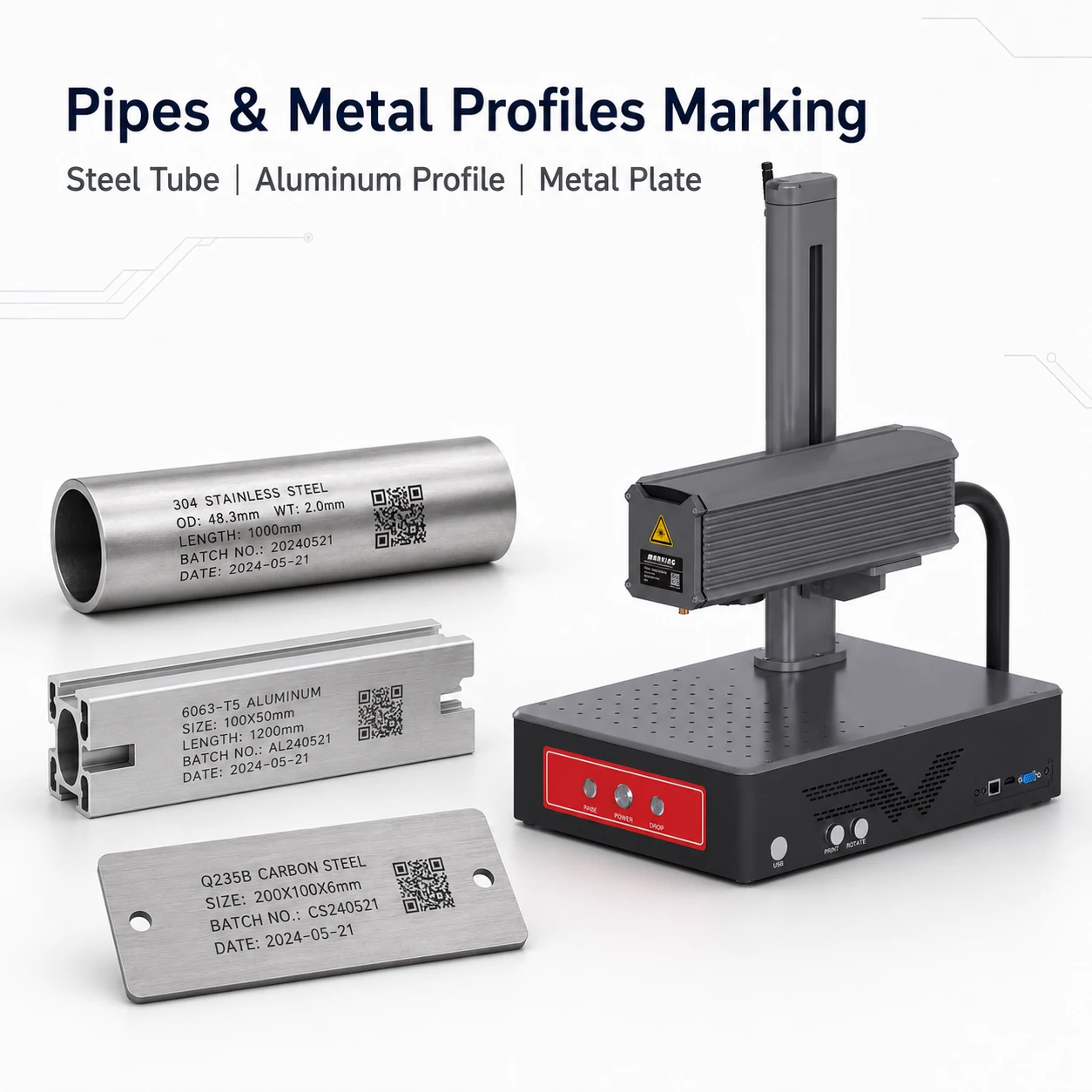
The machine in the image is shown with stainless-steel tubes, aluminum profiles and metal plates. These are common applications in metal workshops, pipe suppliers, hardware factories, machine part producers and OEM processing plants. The marking content is simple but important: material grade, outer diameter, wall thickness, length, batch number and date. A QR code can also be added for internal tracking or customer inspection.
One factory making stainless steel tubes for equipment manufacturers may need to mark “304 Stainless Steel, OD 48.3mm, WT 2.0mm, Batch No.” on each tube sample or cut piece. Another factory producing aluminum profiles may need to mark alloy grade, size and production batch before packaging. A machine builder may need QR codes on metal plates for spare part tracking. These are not high-speed decorative jobs. They are daily traceability jobs.
The key is repeatability.
When a worker marks by hand, the position changes. The text angle changes. Sometimes the mark is too light because the surface is curved or the operator presses unevenly. With a laser marking machine, the part can be placed into a fixture, the marking file stays in the software, and the same content can be repeated batch after batch. For flat plates, this is easy. For round tubes, a simple V-block fixture helps keep the marking area stable. For cylindrical parts that need marking around the surface, a rotary device can be added.
Many overseas buyers ask about material compatibility first. Fiber laser marking is commonly used for stainless steel, carbon steel, aluminum, brass, copper, iron and some coated metals. The effect will differ depending on the surface. Stainless steel can show dark marking. Aluminum may show white, grey or dark contrast depending on alloy and anodizing. Painted or coated plates may expose the base layer after marking. That is why sample testing is important.
A factory should not choose the machine only from a catalog photo. The supplier needs to know the material, surface condition, marking size, depth requirement and daily production volume. If the mark only needs to show text and QR code, normal surface marking may be enough. If the customer wants deep engraving for outdoor parts or anti-tamper identification, the process may require higher laser power or slower marking speed.
Speed also needs a realistic discussion.
A small QR code and several lines of text can usually be finished quickly. But deep engraving on thick steel takes longer. Marking a small nameplate is very different from marking a long steel pipe. Buyers sometimes ask for “fast speed” but do not provide the marking area. A good supplier will ask for sample photos and the exact content. The real question is not only how fast the machine can mark, but whether the whole workflow is smooth: loading, positioning, marking, checking and unloading.
The desktop design is useful for workshops that handle mixed orders. The machine does not need a long conveyor or a full automatic system. It can be placed near cutting machines, inspection tables or packing areas. For a job shop, this flexibility matters. One day they mark stainless steel tubes. The next day they mark aluminum profiles, nameplates or machine parts. The operator only changes the fixture and marking file.
There are also factories that upgrade from pneumatic marking machines to fiber laser marking because of surface quality. Dot peen marking is strong and deep, but it creates impact marks. It can be noisy and may not look clean on aluminum decorative profiles. Laser marking is non-contact, so there is no tool wear and no pressure on the workpiece. For parts with finished surfaces, that is a big advantage.
Another reason for replacement is barcode and QR code readability. Modern warehouses and overseas customers often want codes that can be scanned, not just human-readable text. If a QR code is distorted, too shallow or placed on a rough surface, scanning becomes difficult. Laser marking can create fine code details when the focus and parameters are correct. This helps factories connect physical parts with production records, inspection reports or ERP systems.
However, the laser machine is not magic. Dirty oil, heavy rust, uneven surfaces and poor fixtures can affect the result. Before marking, the surface should be reasonably clean. The part should not move during marking. The focus distance should be correct. Operators need basic training, especially when switching materials. A supplier with factory experience will explain these details instead of only saying “all metals can be marked.”
For overseas B2B buyers, after-sales support is also part of the purchase decision. The machine may be used by workers who are not laser experts. They need clear software instructions, parameter references, video guidance and spare part support. If the buyer is a distributor, they also need sample photos and application cases for local customers. A machine that is easy to demonstrate can help them sell into metalworking, hardware, pipe and machinery industries.
Steel tubes, aluminum profiles and metal plates may look simple, but traceability on these parts is becoming more important. Buyers want to know material grade, batch source and production date. Factories want fewer mistakes in storage and shipping. A compact fiber laser marking machine gives them a clean way to put permanent information directly on the metal surface.
For small and medium metal factories, this kind of machine is often the first step toward a more organized marking process. It reduces dependence on labels, improves part identification, and gives the workshop more control over urgent and customized orders.
Please leave the message you want to inquiry. We will reply you as soon as possible within 24 hours.
Please leave the message you want to inquiry. We will reply you as soon as possible within 24 hours.